The Complete Guide to Local SEO for small businesses: How to Get Your Business Found Online
Category
Content
Posted on
Updated

Author
Daria Nikolaeva
SEO & AI Search
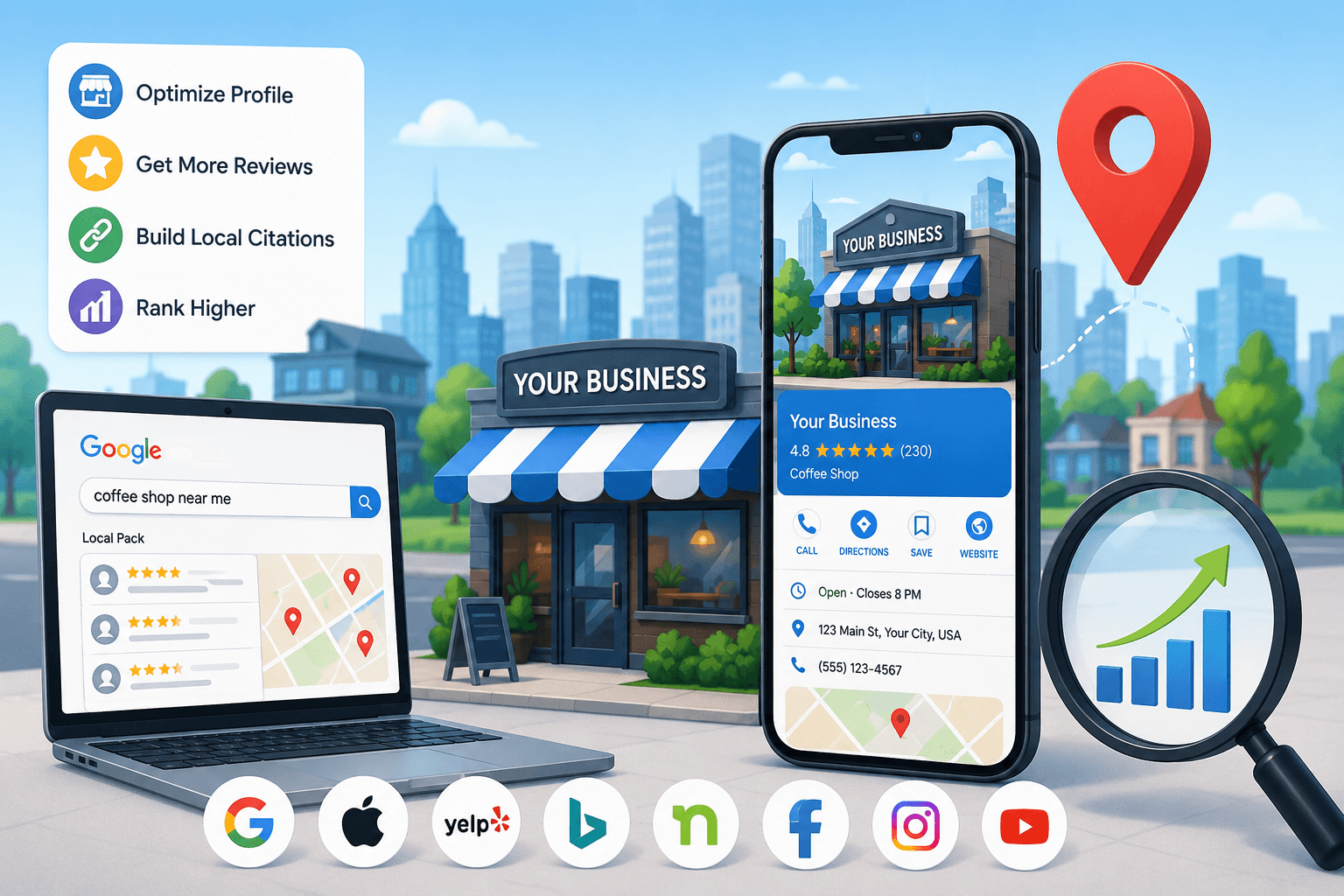
Table of Contents
If you run a business that serves customers in a specific city, neighborhood, or region, local SEO for small businesses is one of the most powerful investments you can make. It's the practice of optimizing your online presence so that people nearby — people actively looking for what you offer — can find you easily. This guide covers everything from the fundamentals to advanced tactics, giving you a clear roadmap to build visibility in your local market.
What Is Local SEO and Why Does It Matter?
Local SEO is the process of improving how your business appears in location-based search results. When someone types "coffee shop near me" or "emergency plumber in Austin," they're performing a local search. The results they see are shaped by a combination of factors: where they are, what they searched for, and how well businesses in the area have optimized their online presence.
Local searches make up a substantial share of all search activity — and they convert at remarkably high rates. People searching for local businesses are often close to making a purchase decision. They may be standing on a sidewalk, sitting in a car, or planning an errand for later that day. That intent to act makes local traffic uniquely valuable.
Search engines display local results in two primary formats. The first is the local pack — a prominent map-based block that appears at or near the top of the results page, showing three to four nearby businesses with their ratings, hours, and contact information. The second is the regular organic results that appear below, where your website can rank based on its content and authority. A comprehensive local seo strategy targets both.
The Three Core Ranking Factors for Local Search
Before diving into tactics, it's essential to understand what search engines are evaluating when they decide which local businesses to show.
1. Proximity
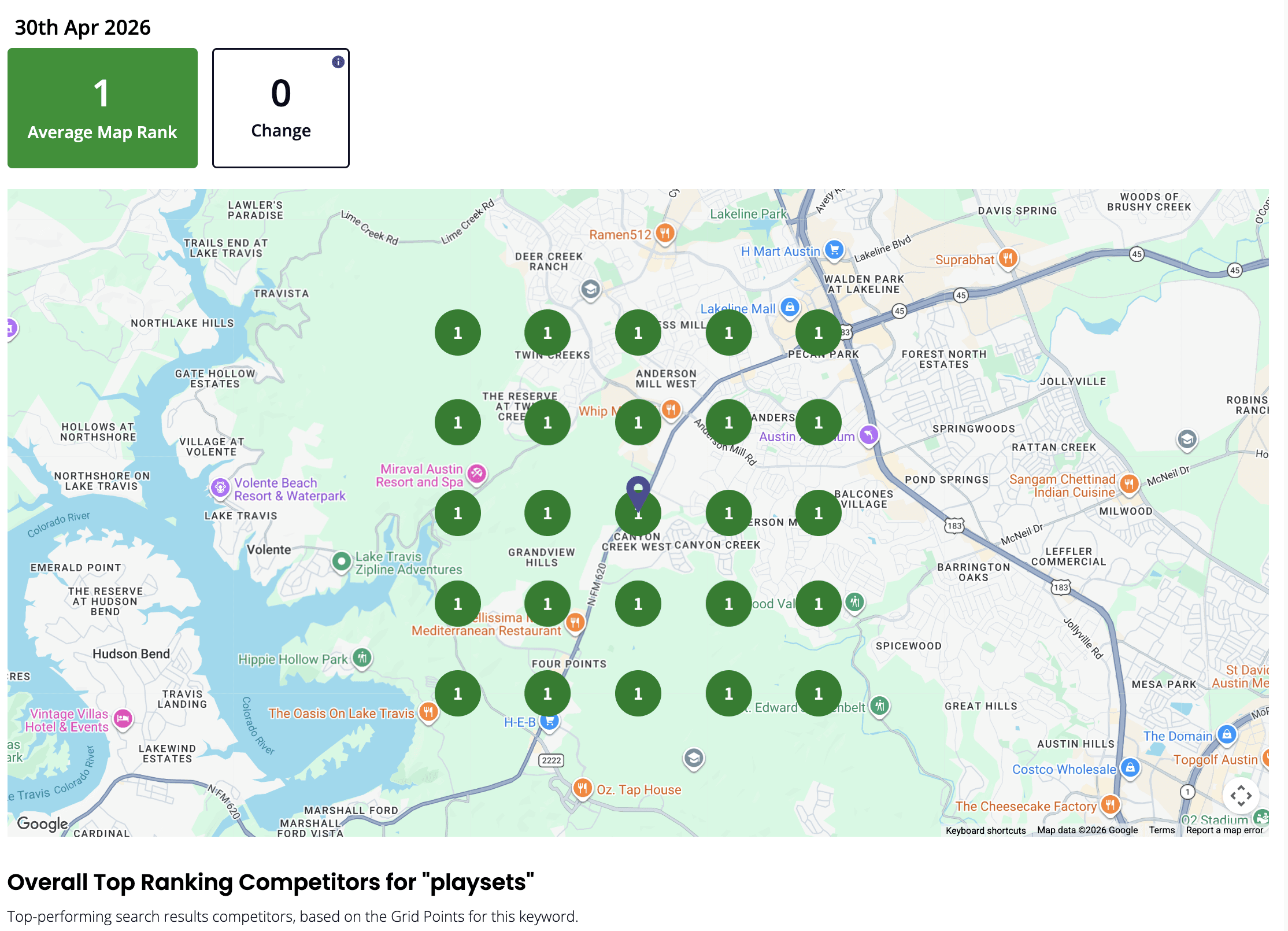
This refers to how physically close a business is to the person conducting the search. When someone searches without specifying a location — just typing "dentist" or "auto repair" — search engines use the device's location to surface results from the immediate area. You can't change where your business is located, but you can make your location data crystal clear so that search engines place you confidently on the map.
When someone includes a location in their query — "dentist in downtown Portland" — the algorithm shifts. Now it's trying to match businesses in that specified area, even if the searcher is currently somewhere else. This is why clearly communicating your service area matters.
2. Relevance
Relevance measures how well your business matches what someone searched for. A search for "locksmith" will return generalists, but a search for "car key replacement locksmith" will prioritize businesses that have clearly communicated that specific service. Every piece of content you publish, every service you list, every word in your business description — all of it contributes to how well search engines can match you to specific queries.
The businesses that rank well for specific, high-intent searches are those that have been thorough and precise in describing what they do. Vague, minimal descriptions work against you.
3. Prominence
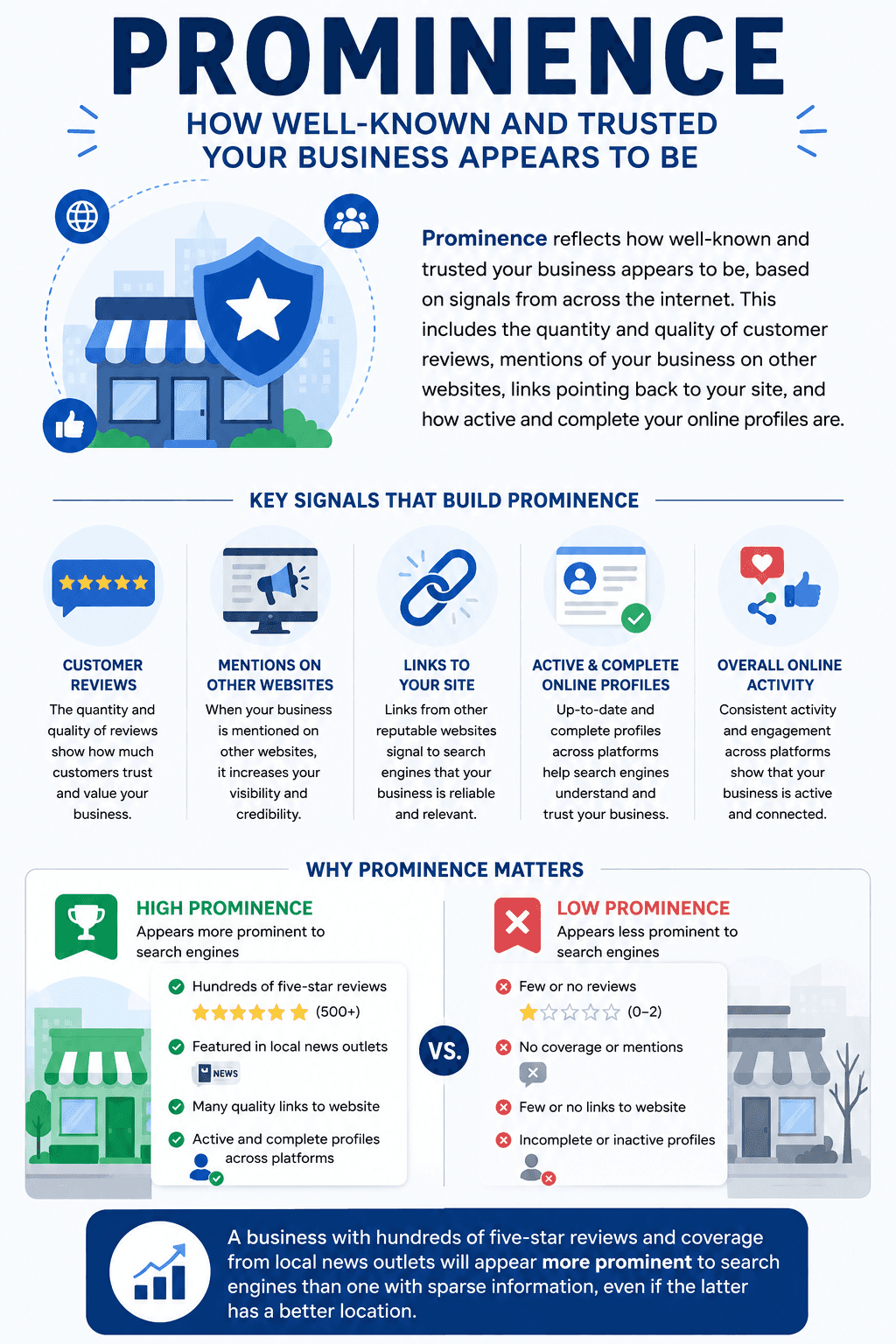
Prominence reflects how well-known and trusted your business appears to be, based on signals from across the internet. This includes the quantity and quality of customer reviews, mentions of your business on other websites, links pointing back to your site, and how active and complete your online profiles are. A business with hundreds of five-star reviews and coverage from local news outlets will appear more prominent to search engines than one with sparse information, even if the latter has a better location.
Setting Up and Optimizing Your Google Business Profile
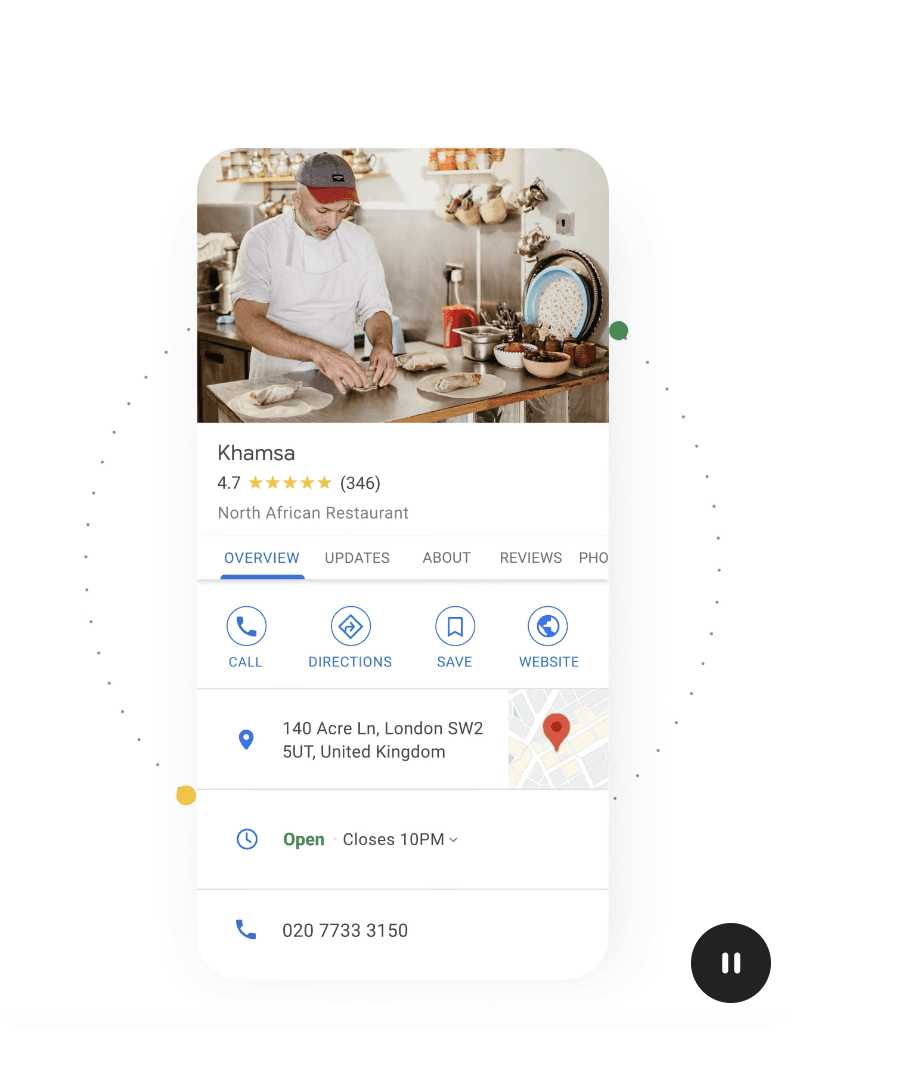
Your Google Business Profile (formerly known as Google My Business) is the single most important asset in local SEO. It's the data source that powers your appearance in the local pack and on Google Maps. Getting it right is non-negotiable.
Claiming and Verifying Your Profile
Start by searching for your business on Google. If a profile already exists, you can claim ownership of it. If not, you'll need to create one from scratch. Either way, verification is required — Google needs to confirm that you're the legitimate owner. This is usually done by postcard, phone call, or video, depending on your business type. Until verification is complete, your profile won't appear in search results.
Filling Out Every Field Completely
Many business owners treat the Google Business Profile as a quick checkbox — enter a name, add a phone number, move on. That's a missed opportunity. The more thoroughly you fill out your profile, the more signals you send to both Google and potential customers.
✅ Business Name: Use your exact, legal business name. Consistency matters here — the name on your profile should match the name on your website, your signage, and every other platform where your business appears. This consistency is referred to as NAP (Name, Address, Phone number) alignment, and it's foundational to local SEO trust.
✅ Categories: Choose your primary category carefully. It should reflect the core of what your business does, not a peripheral service. You can add secondary categories, but don't overload them — a focused profile performs better than a scattered one.
✅ Address and Service Areas: If customers visit your physical location, enter your full address precisely. If you serve customers at their homes or offices — or if you do both — you can also specify your service areas by city, neighborhood, or radius. This helps you appear in searches from areas beyond your immediate block.
✅ Business Hours: Be accurate. Hours that don't reflect reality damage trust the moment a customer shows up to a closed door. If you offer extended or around-the-clock service, mark that clearly — some searchers filter by "open now" or "24 hours," and you'll miss them if your hours aren't set correctly.
✅ Phone Number and Website: Use a phone number that's consistent across all your online profiles. Your website URL should go directly to the most relevant page — usually your homepage, or a specific location page if you have multiple branches.
✅ Business Description: You have up to 750 characters to describe your business in plain language. Use this space to communicate what makes you stand out, what services you offer, how long you've been operating, and anything else that helps a potential customer understand why they should choose you. Write for humans first, but naturally include relevant terms your customers would search for.
✅ Photos and Videos: Visual content builds trust before a customer ever contacts you. Add photos of your storefront, your team at work, your products or completed projects, and your interior. Businesses with rich photo galleries signal that they're active and legitimate. Update your photos periodically — stale imagery from years ago suggests a business that isn't engaged with its profile.
✅ Products and Services: Many business types can list specific products or services directly on their profile. Use this feature to communicate your full range of offerings and to naturally include keywords your customers use when searching.
NAP Consistency: The Foundation of Local Trust
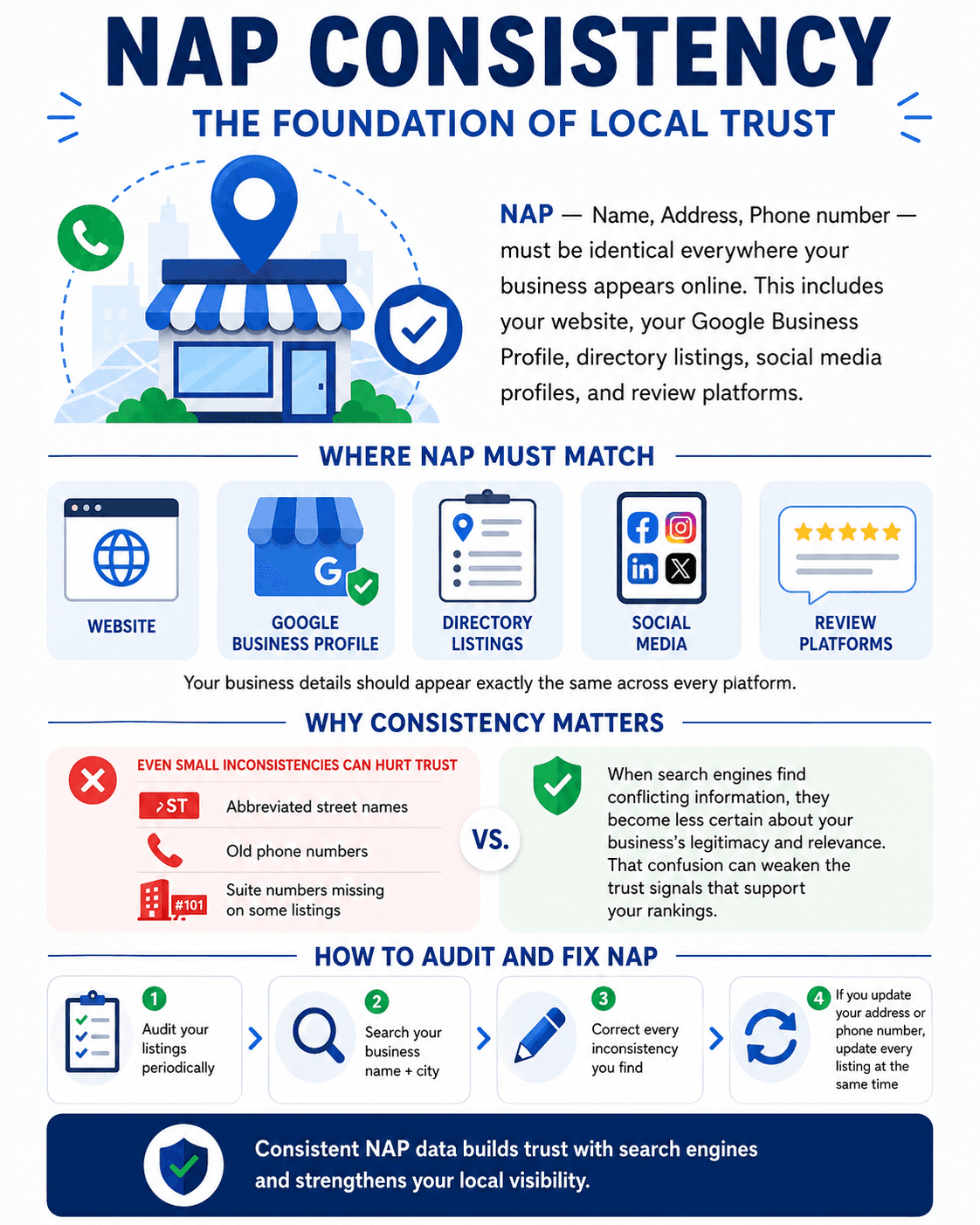
NAP — Name, Address, Phone number — must be identical everywhere your business appears online. This includes your website, your Google Business Profile, any directory listings, social media profiles, and review platforms.
Even small inconsistencies — an abbreviated street name here, an old phone number there, a suite number that appears on some listings but not others — can confuse search engines and erode the trust signals that support your rankings. When search engines encounter conflicting information, they become less certain about your business's legitimacy and relevance.
Audit your existing listings periodically. Search for your business name along with your city and look at what appears. Correct any inconsistencies you find. If you're updating your address or phone number, update every listing simultaneously rather than doing it piecemeal.
Building Your Local SEO Foundation on Your Website
Your Google Business Profile handles your presence on the map. Your website handles your organic search rankings — and the two work together. A well-optimized website reinforces the trust signals from your business profile and helps you rank for the full range of local searches that your customers conduct.
Schema Markup for Local Businesses
Schema markup is structured data added to your website's code that tells search engines specific facts about your business: your name, address, phone number, business type, hours of operation, and more. It doesn't change how your website looks to visitors, but it gives search engines a clear, machine-readable summary of your business information.
For local businesses, the most important schema type is LocalBusiness (or a more specific subtype that fits your industry). Adding local business schema to your site — especially to your homepage and any location-specific pages — reinforces your NAP data, communicates your business type, and can enhance how your site appears in search results.
{
"@context": "https://schema.org",
"@type": "LocalBusiness",
"name": "Your Business Name",
"description": "A brief description of your business and the services you offer.",
"url": "https://www.yourbusiness.com",
"logo": "https://www.yourbusiness.com/images/logo.png",
"image": "https://www.yourbusiness.com/images/storefront.jpg",
"telephone": "+1-555-000-0000",
"email": "contact@yourbusiness.com",
"priceRange": "$$",
"address": {
"@type": "PostalAddress",
"streetAddress": "123 Main Street",
"addressLocality": "Your City",
"addressRegion": "CA",
"postalCode": "90210",
"addressCountry": "US"
},
"geo": {
"@type": "GeoCoordinates",
"latitude": 34.0522,
"longitude": -118.2437
},
"openingHoursSpecification": [
{
"@type": "OpeningHoursSpecification",
"dayOfWeek": ["Monday", "Tuesday", "Wednesday", "Thursday", "Friday"],
"opens": "09:00",
"closes": "17:00"
},
{
"@type": "OpeningHoursSpecification",
"dayOfWeek": "Saturday",
"opens": "10:00",
"closes": "14:00"
}
],
"sameAs": [
"https://www.facebook.com/yourbusiness",
"https://www.instagram.com/yourbusiness",
"https://www.yelp.com/biz/yourbusiness"
]
}
Location Pages
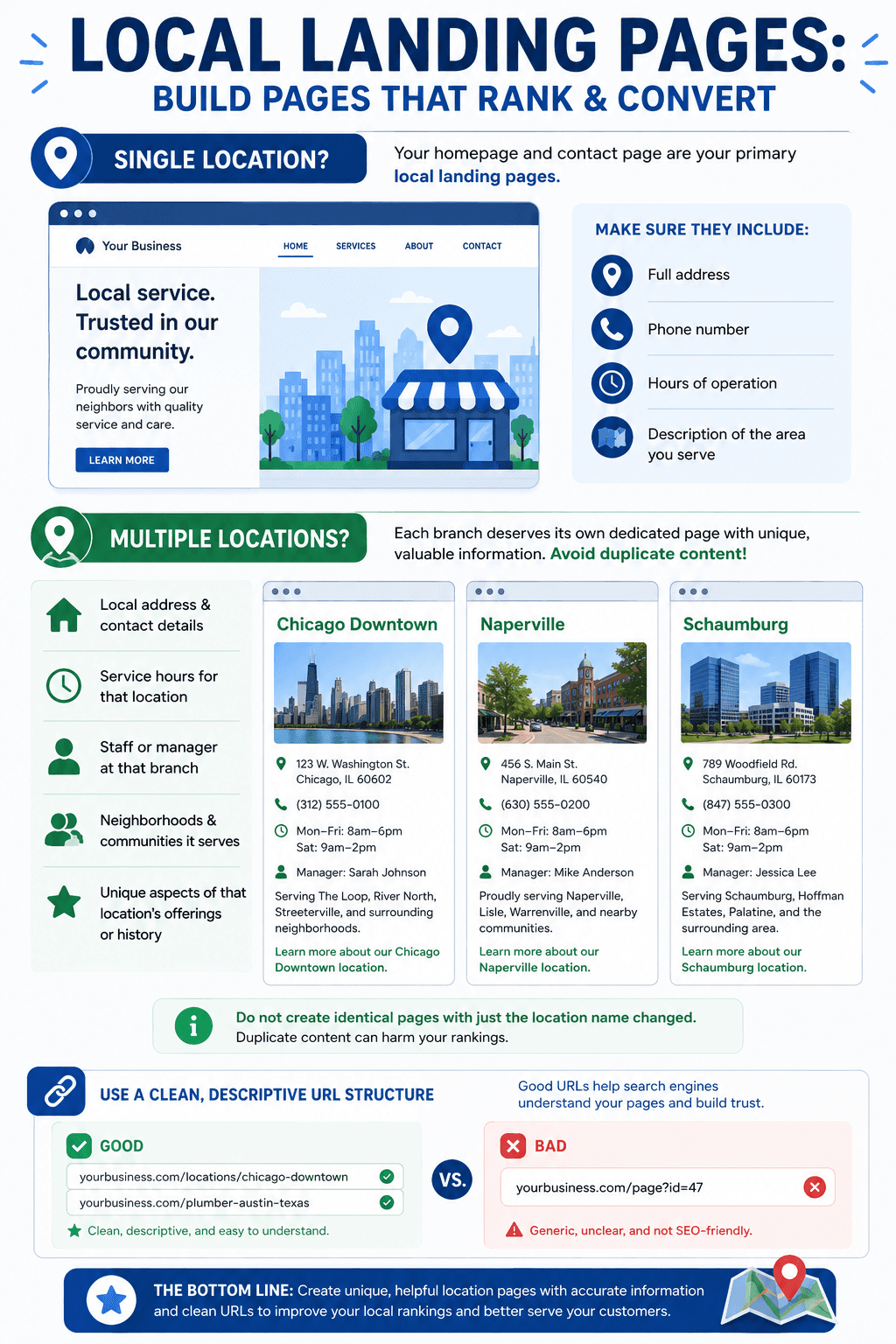
If your business has a single location, your homepage and contact page serve as your primary local landing pages. Make sure they include your full address, phone number, hours, and a description of the area you serve.
If your business has multiple locations, each branch deserves its own dedicated page. These pages should not be identical to each other with just the location name swapped out — that's duplicate content, which can harm your rankings. Instead, each location page should contain information specific to that branch: the local address and contact details, service hours for that location, the staff or manager at that branch, the neighborhoods and communities it serves, and any unique aspects of that particular location's offerings or history.
The URL structure for location pages matters. Keep it clean and descriptive: something like /locations/chicago-downtown or /plumber-austin-texas is far more effective than /page?id=47.
Local Keyword Research
Before writing content for your website, understand what your potential customers are actually searching for. Local keyword research reveals the exact phrases people use when looking for businesses like yours — and it often surfaces opportunities that you wouldn't have guessed.
Start with your core services and add location modifiers: your city, neighborhood names, nearby landmarks, and regional terms. Also look for service-specific modifiers: "emergency," "24-hour," "licensed," "same-day," "affordable." The combination of a service term, a quality modifier, and a location is often where the most valuable local search traffic lives.
Pay attention to search intent. Someone searching "how to unclog a drain" is looking for information and may not be ready to hire a plumber. Someone searching "emergency plumber near me at 11 pm" is ready to hire right now. Your content strategy should address both types — informational content builds long-term authority, while service-focused pages capture immediate demand.
Content Strategy for Local Businesses
One of the most durable advantages you can build in local SEO is a library of genuinely useful content tailored to your local market. This content serves your customers, earns you authority, and creates more pathways for people to find your business.
Service Pages with Local Focus
Each of your core services deserves its own dedicated page — not a paragraph buried on your homepage. A thorough service page explains what the service involves, who needs it, how your business performs it, what the process looks like, and what outcomes customers can expect. Include your location throughout the content naturally: the neighborhoods you serve, the local codes or regulations relevant to that service, examples from local projects.
These pages target the high-intent searches from people who are ready to hire. They're among the most valuable pages on your website.
Blog and Educational Content
Informational content targeting local searches builds awareness and authority over time. A roofing company might write about common roof problems in climates like yours, how to prepare for storm season in your region, or what the local permit process looks like. A restaurant might write about the history of a cuisine they specialize in or what makes their neighborhood a destination for food lovers.
This kind of content attracts visitors at earlier stages of their decision-making process. It positions your business as knowledgeable and trustworthy — the kind of business people feel good about contacting when they're ready.
Avoiding Duplicate Content
When you have multiple location pages, the temptation is to write one page and clone it with different city names dropped in. Resist this. Search engines can identify near-duplicate content, and it can suppress your rankings rather than boost them.
The solution is to make each page genuinely location-specific. The service description framework might be similar, but the details should differ: different staff profiles, different response time estimates for different service areas, local landmarks or neighborhoods referenced naturally, testimonials from customers in that specific area. That specificity is what makes each page valuable and unique.
Building Prominence Through Reviews and Reputation
Reviews are among the most visible and influential signals in local SEO. They affect both your rankings and your conversion rate — a business with dozens of detailed, positive reviews will win more clicks and inquiries than one with none, even if both appear in the same search results.
Getting More Reviews
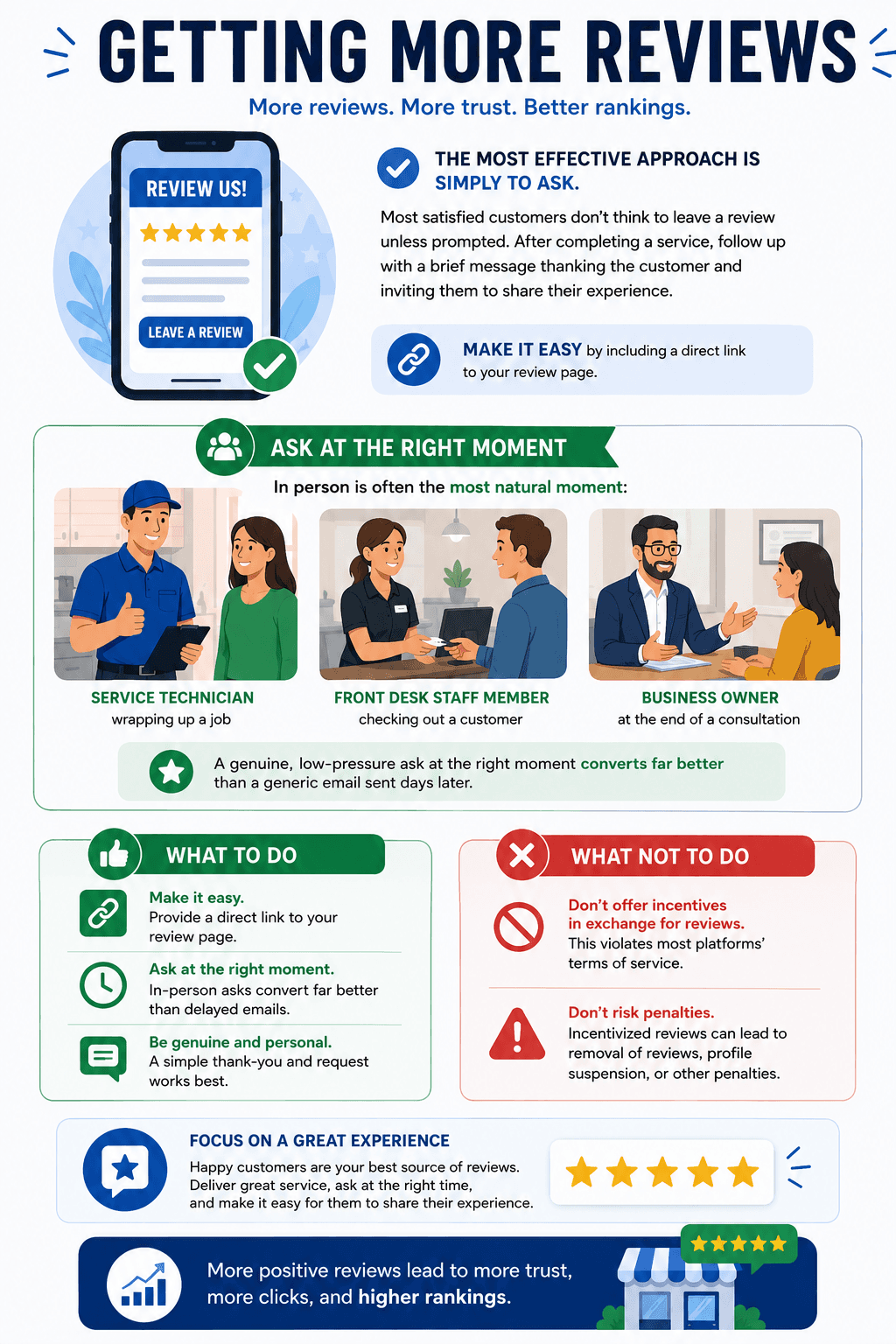
The most effective approach is simply to ask. Most satisfied customers don't think to leave a review unless prompted. After completing a service, follow up with a brief message thanking the customer and inviting them to share their experience. Make it easy by including a direct link to your review page.
In person is often the most natural moment: a service technician wrapping up a job, a front desk staff member checking out a customer, a business owner at the end of a consultation. A genuine, low-pressure ask at the right moment converts far better than a generic email sent days later.
Don't offer incentives in exchange for reviews — this violates most platforms' terms of service and can result in penalties. What you can do is make the process frictionless and remind customers at the right moment.
Responding to Every Review
Respond to all reviews, positive and negative. For positive reviews, a brief, genuine thank-you reinforces the relationship and shows prospective customers that you're engaged and appreciative. For negative reviews, your response matters even more.
When you receive a critical review, stay calm and professional. Acknowledge the customer's experience without becoming defensive. Offer to make it right and provide a way to continue the conversation privately. A thoughtful, constructive response to a negative review can actually improve your reputation — it demonstrates maturity, accountability, and genuine care for customers. Prospective customers read your responses just as carefully as the reviews themselves.
Building Authority Through Citations and Backlinks
Directory Listings (Citations)
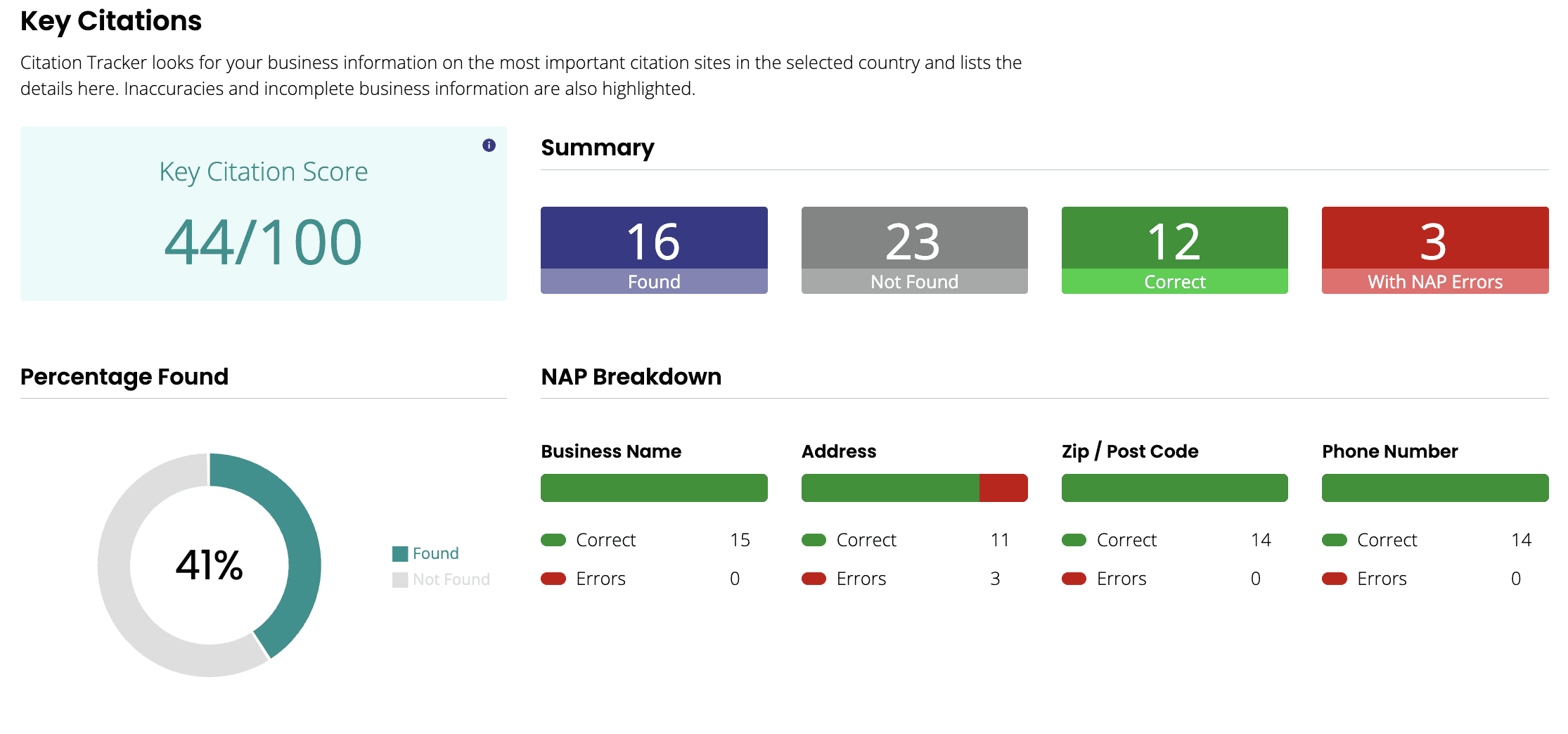
A citation is any online mention of your business's name, address, and phone number. These appear in business directories, local chamber of commerce websites, industry-specific platforms, and review sites. They serve as corroborating evidence that your business exists at a specific location and has the contact information you've listed.
Claim and complete your listing on major platforms relevant to your business: general directories that cover businesses broadly, as well as industry-specific directories that serve your particular field. The value isn't just SEO — many customers use these platforms directly to find businesses, so being listed means reaching an additional audience.
Consistency remains critical here. Every citation should match your Google Business Profile exactly. Use the same formatting for your address, the same phone number, the same business name.
Earning Backlinks from Local Sources
Backlinks — links from other websites to yours — are one of the strongest signals of authority in search rankings. For local businesses, the most valuable backlinks tend to come from locally relevant sources: local news coverage, community organization websites, local blogs, business association pages, and event sponsorship listings.
You earn these by being an active presence in your local community and by doing work worth writing about. Sponsor a local event. Participate in a community initiative. Provide expert commentary to local journalists covering topics in your field. Collaborate with complementary local businesses. These activities build real relationships and often produce natural backlinks as a byproduct.
Avoid purchasing links from low-quality directories or link farms. The short-term ranking boost isn't worth the long-term risk of a penalty.
Expanding Your Reach: Beyond Google
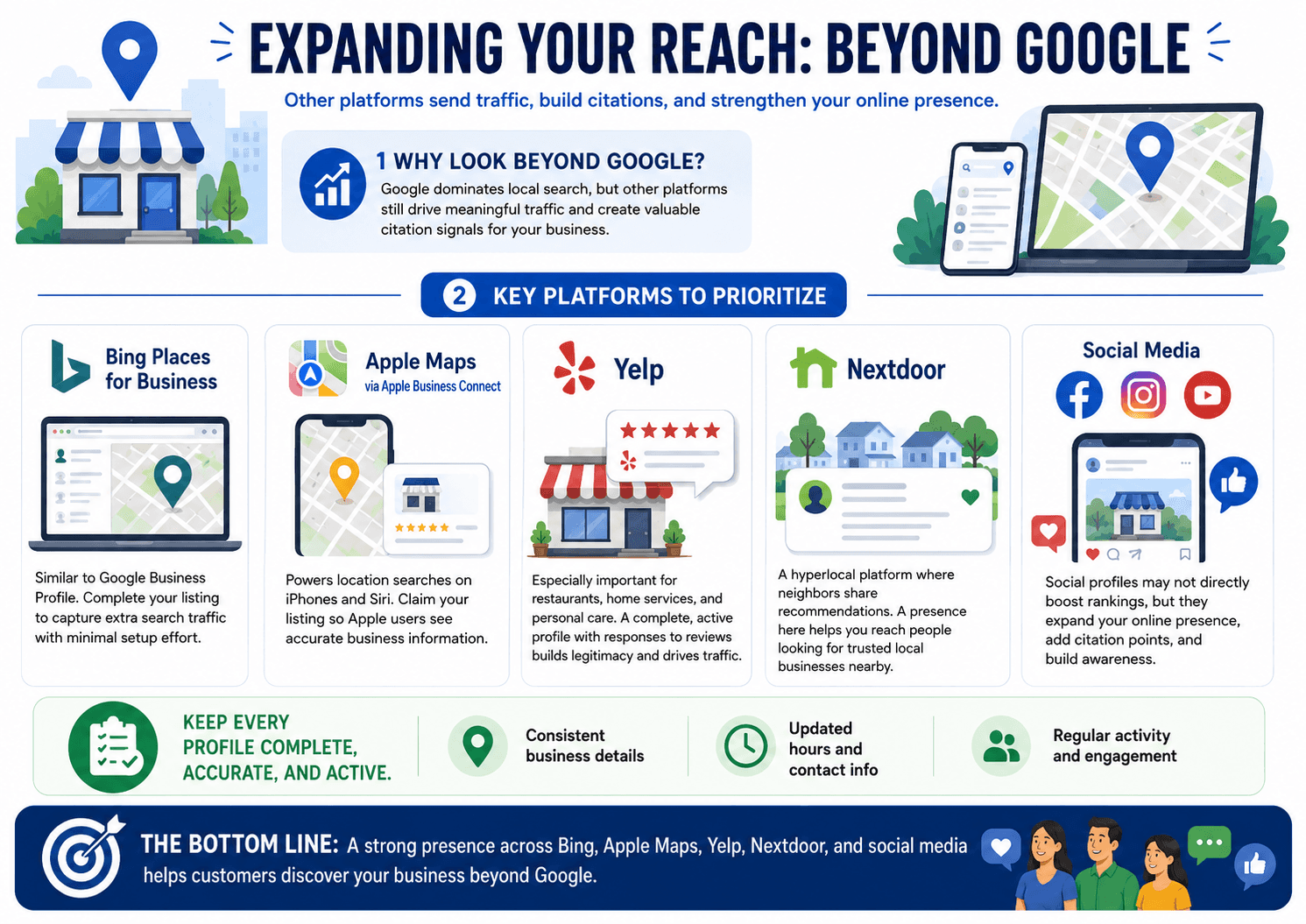
While Google dominates local search, other platforms send meaningful traffic and provide additional citation signals.
Bing Places for Business mirrors much of the Google Business Profile experience and deserves a complete listing. Bing's share of search traffic is smaller but not negligible, and the setup investment is minimal.
Apple Maps powers location searches on iPhones and Siri. Claim your listing through Apple Business Connect to ensure your information is accurate for Apple's large user base.
Yelp remains significant, particularly for restaurants, home services, and personal care businesses. A complete, active profile with responded-to reviews signals legitimacy and drives traffic independently of Google.
Nextdoor is a hyperlocal platform where neighborhood residents share recommendations. Creating a presence there puts your business in front of people actively looking for local recommendations in their immediate community.
Social media profiles don't directly influence search rankings in the same way, but they contribute to your overall online presence, create additional citation points, and build awareness. An active Facebook page, Instagram presence, or YouTube channel keeps your business visible to people who discover you through social channels rather than search.
Measuring and Improving Your Local SEO Performance
Local SEO for small businesses isn't a one-time setup — it's an ongoing process that rewards attention and consistency.
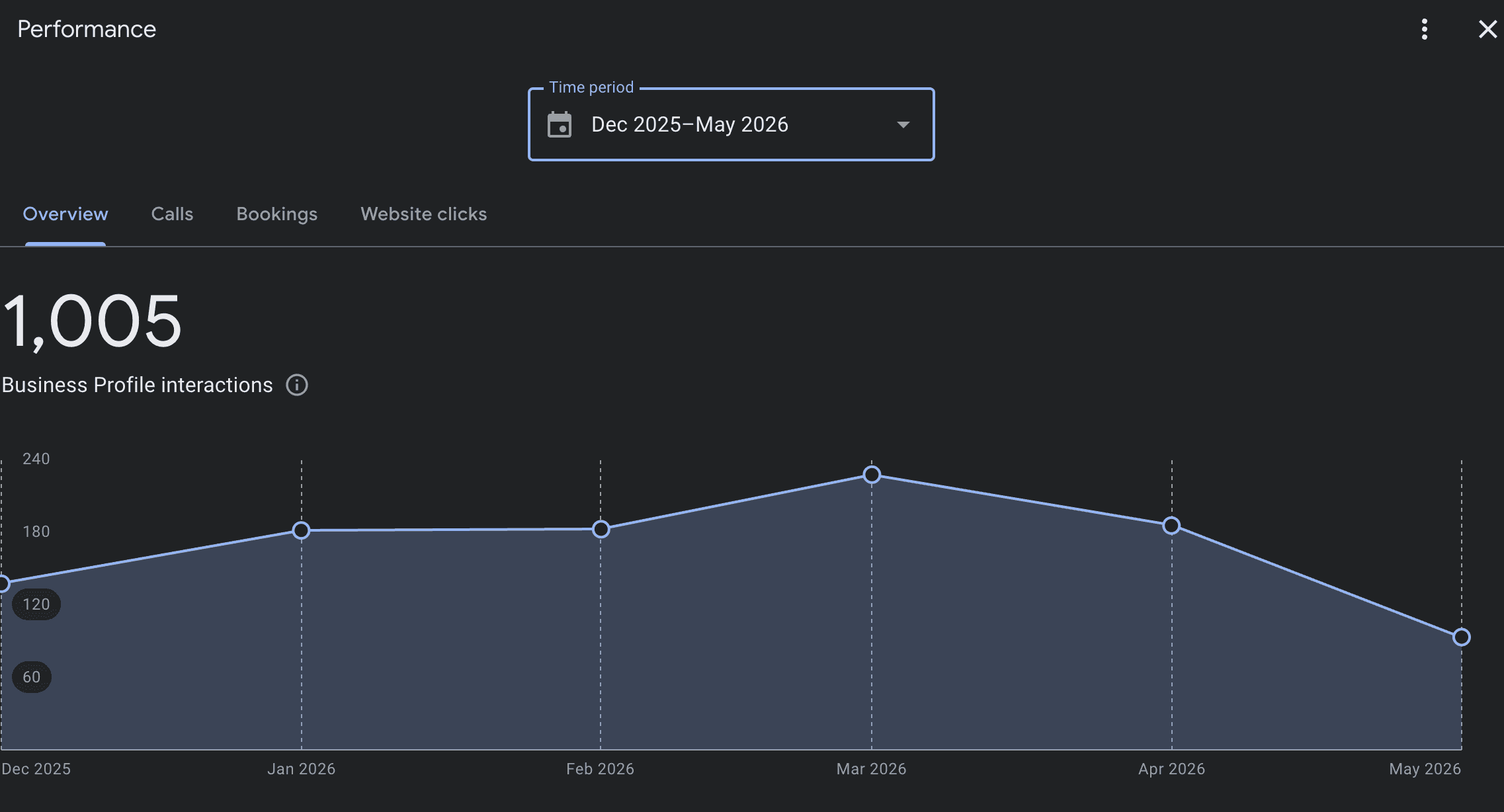
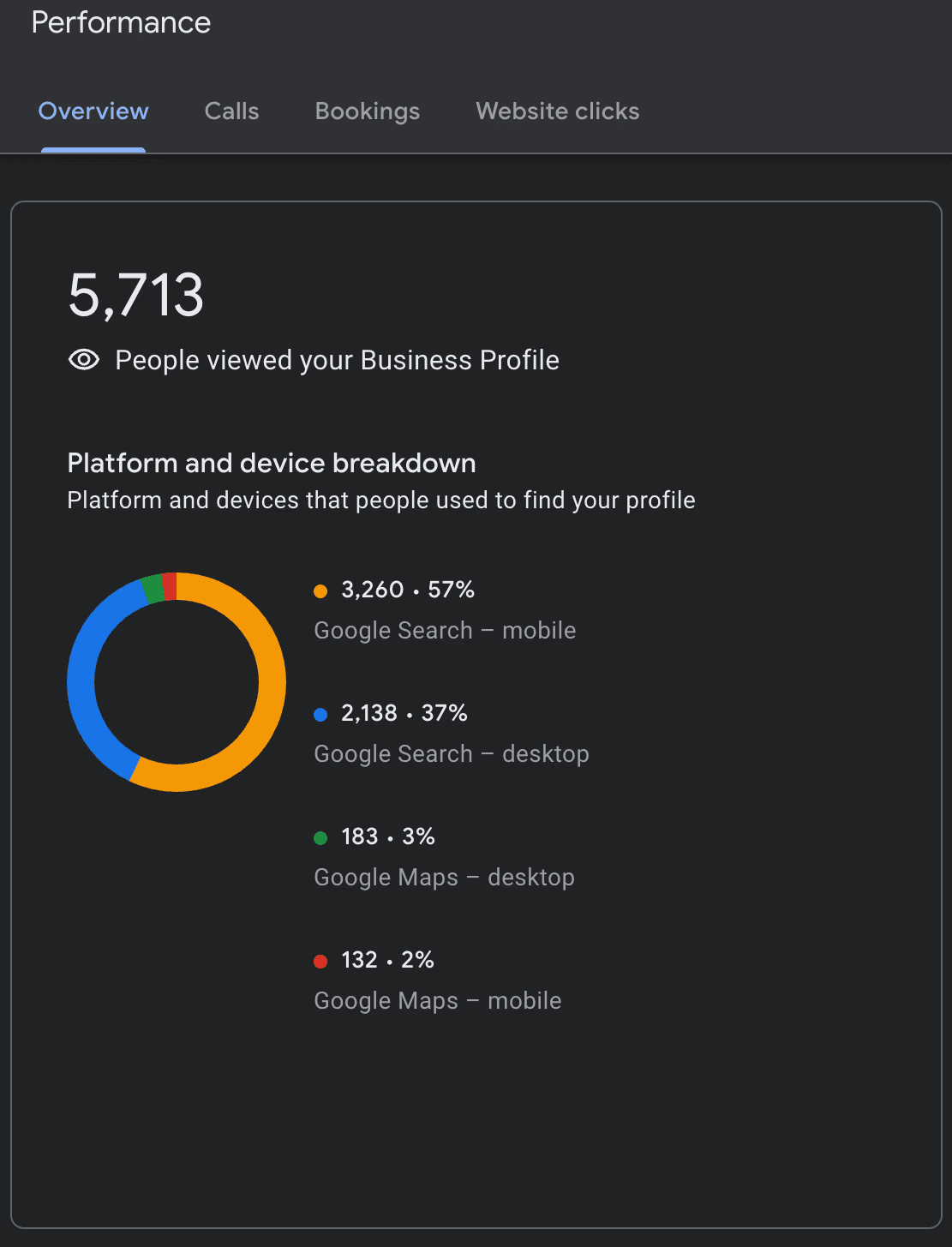
Monitor your Google Business Profile insights to understand how people are finding your profile, what actions they're taking, and which photos or posts generate the most engagement. Track the keywords driving traffic to your website and the pages that capture the most local search visitors. Watch for new reviews and respond promptly.
Check your rankings periodically for the most important local search terms in your market. Note any changes — positive or negative — and investigate what might have caused them. Rankings can shift based on competitor activity, changes to your own profile or website, or algorithm updates.
Set a recurring reminder to audit your NAP consistency across the web. Business information changes over time — phone numbers, addresses, hours — and old listings can persist long after you've made updates. Staying on top of this is a competitive advantage that many businesses neglect.
Summary: The Local SEO Checklist
To build a strong local SEO foundation, work through these core areas:
Google Business Profile
Claim and verify your profile
Complete every available field
Choose accurate categories
Maintain consistent NAP across all platforms
Add high-quality photos and keep them updated
List your products and services in detail
Respond to all reviews
Website Optimization
add local business schema markup
Create dedicated location pages for each branch
Develop service pages with local context
Build informational content targeting local searches
Ensure NAP on your site matches your Google profile exactly
Reputation and Authority
Actively request reviews from satisfied customers
Respond to all reviews professionally
Build citations in relevant directories
Earn backlinks through local community involvement
Ongoing Maintenance
Monitor profile insights and website analytics
Audit NAP consistency regularly
Update hours, photos, and information as they change
Stay active: new posts, new photos, prompt review responses
Local SEO rewards businesses that commit to it consistently. The businesses that win local search aren't always the biggest or the oldest — they're the ones that have been most deliberate about their online presence, most responsive to their customers, and most active in their communities. Every step you take in the right direction compounds over time.
Let’s talk about your next step.
Schedule a free 15-minute consultation with SOURCEsem. Tell us about your business, ask your questions, and get clarity on where to focus next.


