
The GEO Mistake Small Businesses Keep Making (And What to Do Instead)
Category
Content
Posted on
Updated

Author
Daria Nikolaeva
SEO & AI Search
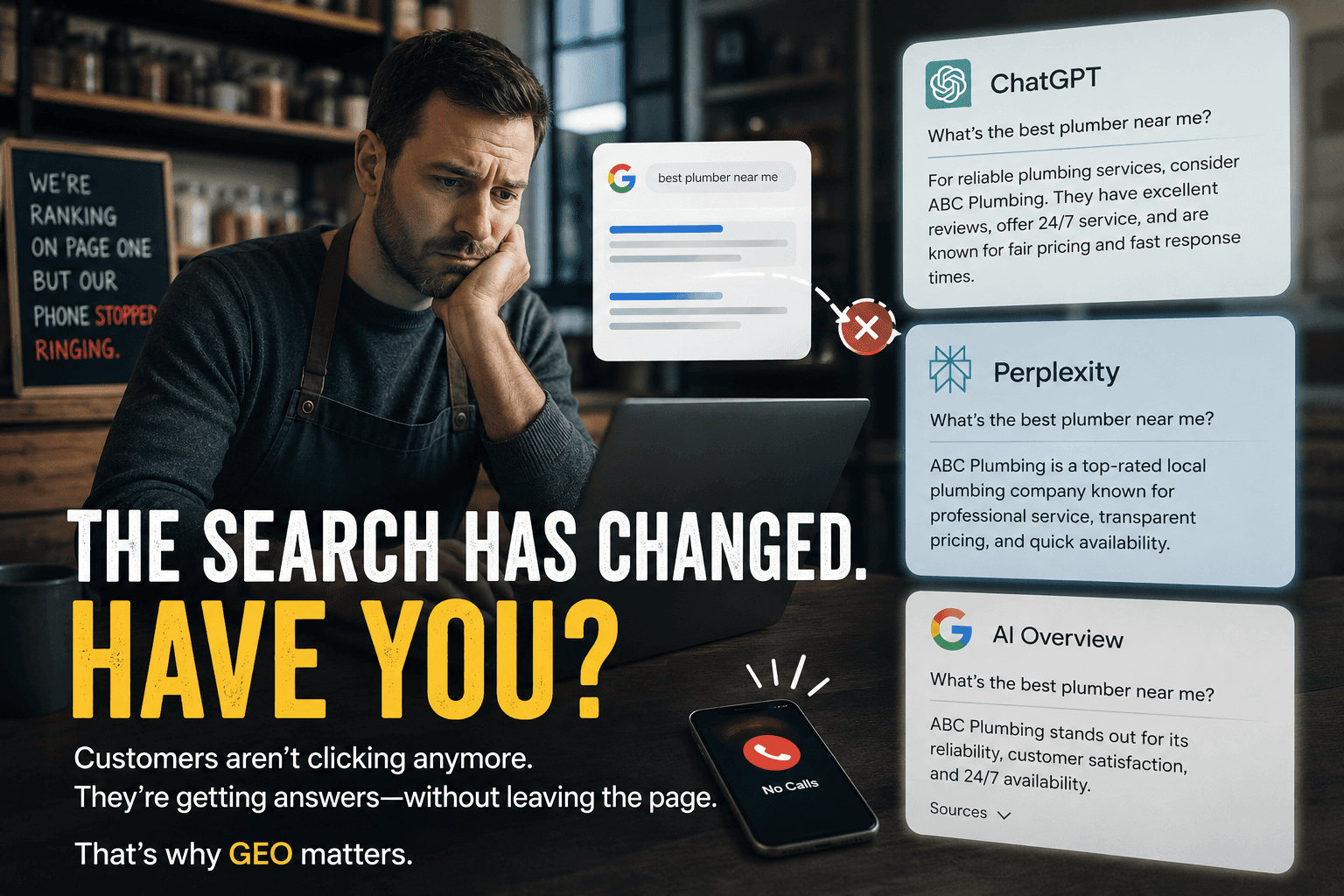
Table of Contents
A small business owner recently shared something that stopped me mid-scroll: "We're ranking on page one of Google, but our phone stopped ringing."
Their SEO was technically fine. Traffic was steady. But something had shifted. Their customers weren't clicking through search results anymore — they were asking ChatGPT, Perplexity, and Google's AI Overviews for direct answers. And those tools were giving them one, without ever sending a visitor to any website.
That's the world your business is operating in right now. And it's exactly why so many SMBs are picking up the term Generative Engine Optimization — GEO for short — and immediately going down the wrong path.
What GEO Actually Is (In Plain English)
Generative Engine Optimization is the practice of structuring your content so that AI systems — ChatGPT, Perplexity, Google AI Overviews, Gemini, Copilot — are likely to cite your business when answering questions your customers are asking.
It doesn't replace SEO. Think of it as a layer on top of what you're already doing. Traditional SEO still earns you Google rankings — and if you want a full breakdown of how that foundation connects to ai search, the three pillars of AI search optimization cover exactly that. Traditional SEO still earns you Google rankings; GEO earns you mentions in the AI-generated answers that increasingly appear before those rankings even come into view. Developing an AI content strategy means thinking about both layers simultaneously — what ranks and what gets cited.
The numbers behind this shift are hard to ignore. According to Gartner, traditional search engine volume is projected to drop 25% by the end of 2026 as users migrate to AI-generated answers. Research from Ahrefs found that 63% of websites are already receiving traffic from AI search tools. And AI referral traffic to small business websites grew 123% in a short window in 2025 alone.
Here's the part that should get your attention as an SMB owner: most of your competitors haven't started. Nearly 47% of brands currently have no GEO strategy. That's a real first-mover window — but only if you approach it correctly.
Content Strategy in the Age of AI Has Changed the Rules
For years, a solid content plan meant keyword research, a publishing calendar, and a steady stream of blog posts targeting your best search terms. That still matters. But content strategy in the age of AI adds a new requirement: your content doesn't just need to rank — it needs to be quotable.
AI systems don't send users to a list of ten links. They synthesize an answer, pull from sources they consider credible, and deliver a response directly. If your business isn't among those sources, you're invisible in that moment — even if your Google ranking is strong.
This creates a real strategic shift for how SMBs think about artificial intelligence marketing. The goal is no longer just traffic. It's authority. It's being the business that AI systems reach for when your customers ask the questions you should own.
The Trap: Chasing "Prompt Volume"
Most GEO advice starts with the same instruction: find the prompts people are typing into AI tools, track which ones give your brand visibility, and build content around the highest-volume queries.
That advice sounds logical. It mirrors how keyword research works in traditional SEO. The problem is that the underlying data simply doesn't exist yet.
Unlike Google, which measures and shares search volume data, AI platforms don't publish query frequency. There is no verified equivalent to Google Search Console for ChatGPT or Perplexity. What GEO tools label as "prompt volume" is a modeled estimate — a best-guess extrapolation, not a measurement.
This matters for a few reasons beyond just data accuracy.
AI responses aren't consistent. The same prompt can produce a completely different answer on different days, in different sessions, or even in the same conversation. This isn't a bug — it's how large language models work. They generate text probabilistically, not deterministically. Research published in January 2026 by Rand Fishkin and Gumshoe.ai, testing nearly 3,000 prompts across hundreds of real users on ChatGPT, Claude, and Google AI, found less than a one-in-100 chance of getting the same brand list in any two responses. Any tool claiming to show you your "AI ranking position" is, in Fishkin's own words, essentially making it up.
Citation patterns shift constantly. Even when you hold the prompt identical, which brands get mentioned month to month changes dramatically. Studies measuring citation drift have found swings of dozens of percentage points across Google AI Overviews and ChatGPT in a single month. A piece of content that earns citation in April may be invisible in May.
The tools are early. We are in what you might call a pre-Semrush era for GEO. The data infrastructure that makes SEO trackable and actionable took years to build. GEO measurement infrastructure is nowhere near that mature. Treat any GEO platform data as directional and useful for general awareness — not as the foundation for your content investment decisions.
This doesn't mean GEO isn't worth pursuing. It means the strategy has to be built on something more stable than estimated prompt volume.
How to Use AI in Your Content Strategy (Without Building on Sand)
1. Start with your customers, not a dashboard
The most reliable input you have is your own knowledge of who buys from you and why. What problems are they trying to solve? What language do they use to describe those problems? What questions do they ask before they decide to hire someone like you?
If you've done solid customer research — even informal conversations with five or ten of your best clients — you're already sitting on better GEO intelligence than any third-party tool can provide. Your customers' language is exactly the language they're using to prompt ai tools. Build your content around that, not around a vendor's estimated query list.
2. Identify and Fill Content Gaps in Your AI Search Engine Strategy
One of the most underused tactics for SMBs is actively identifying content gaps in your AI search engine strategy. This means asking: what questions are my customers typing into ChatGPT or Perplexity that I have no good answer for on my site?
Start by going where your audience already speaks openly. Reddit threads in your industry, niche forums, LinkedIn comment sections, review platforms like G2 or Trustpilot, and local Facebook groups are all places where real buyers phrase real questions in natural language. That unfiltered language is precisely what AI systems are trained on and what they reward.
If your ideal customers are consistently asking a particular question in a subreddit or review thread, that's a more reliable content brief than any modeled prompt volume number. Third-party community mentions also matter directly: Reddit, LinkedIn, and YouTube were among the top-cited sources by major AI platforms as recently as late 2025. Your presence in those conversations has real GEO value.
3. Mine your own customer conversations
Your sales team, support inbox, and onboarding calls are goldmines that most SMBs leave completely untapped for content purposes.
The objections your salespeople hear every week. The questions your support team answers over and over. The confusion points that surface in every onboarding call. That language belongs in your content. If a prospect asks the same question every sales call, there's a strong chance someone is asking an AI the same thing — and whoever answers it clearly and specifically is getting the citation.
4. How to Create an AI-Powered Content Strategy That Actually Earns Citations
Here's the question most SMBs struggle with: how do you create an AI-powered content strategy when the tools and data are still evolving?
The answer is to organize your content around topic clusters — groups of related questions your customers are asking — rather than treating each keyword or prompt as an isolated target. Pick three to five core themes that sit at the intersection of what your business does well and what your customers genuinely need to understand. Build a central page that answers the big question, then create supporting content around the sub-questions that orbit it.
This approach works for both traditional SEO and GEO simultaneously. It signals topical authority to Google's algorithms and gives AI systems a coherent, interconnected body of content to draw from when generating answers. A single well-researched cornerstone page with five supporting articles will consistently outperform twenty isolated posts chasing individual keywords.
5. Strategies for Optimizing Content for Google AI Overviews
The structural question of optimizing content for Google AI Overviews — and for AI tools more broadly — comes down to a few consistent principles.
Lead with a direct answer before elaborating. Use H2 and H3 headings that mirror real questions ("How much does this typically cost for a small business?" performs better than "Pricing Overview"). Include specific, attributable data points where possible — a stat like "AI referral traffic to small businesses grew 123% in 2025" is far more likely to be cited than "AI traffic is growing." Build FAQ sections that match the conversational format of how people prompt AI tools. Research suggests content structured this way shows 30 to 40% higher visibility in AI-generated answers.
One thing worth flagging on how to integrate AI writing tools with your content strategy: AI-generated drafts that are generic and interchangeable with thousands of similar posts will not earn citations. AI systems reward demonstrated understanding and specific expertise. Use AI content creation tools to accelerate drafting and editing — they're genuinely useful for speed — but make sure the final content reflects your real expertise and specific customer knowledge. That's what makes it citable. Generic AI output won't get you cited by AI.
6. Build your external reputation deliberately
One of the most consistent findings across GEO research is that AI systems need external validation to confidently cite a source. Approximately 82% of AI citations come from earned media — third-party mentions, reviews, and references — rather than owned content alone.
For an SMB, this means a few practical priorities. Complete and accurate profiles on relevant directories and review platforms. Encourage and respond to customer reviews (research from Search Engine Land suggests 88% of consumers would use a business that responds to all reviews, versus 47% who would trust one that stays silent). Pitch expert commentary to local news outlets or industry blogs. Participate substantively in relevant online communities.
When your business is mentioned consistently across multiple credible sources tied to a clear area of expertise, AI systems have the confidence to reference you. Without that external signal, even excellent on-site content may not be enough.
7. How to Compare AI Content Strategy Visibility with Competitors
Once you have a baseline GEO strategy running, you need a way to compare your AI content strategy visibility with competitors — without over-indexing on noisy, month-to-month data.
A practical approach: identify 20 to 30 prompts that reflect your customers' most common questions. Run them monthly across the platforms your audience uses most — ChatGPT, Perplexity, Google AI Overviews. Note whether your brand, your content, or your competitors appear. Track changes without overreacting to single-month swings. What you're watching for is directional trends over three to six months, not week-to-week positions.
You can also track AI-referred sessions in GA4 by identifying traffic from known AI platform domains. It's imperfect, but it's real data tied to actual behavior — more reliable than estimated prompt volume as a signal of whether your AI-driven marketing efforts are compounding over time. Watching your AI-referred traffic share grow relative to competitors is a more honest benchmark than any point-in-time "AI ranking."
A Practical Starting Point for This Week
If you're new to GEO and want to take one concrete action today, start here:
Audit your five most important service or product pages. Read each one out loud. Can an AI system extract who this is for, what problem it solves, what the process looks like, and why you're credible — in two or three confident sentences? If not, that's your rewrite priority. Add a direct answer at the top, restructure headings as questions, include one specific data point or case result, and add a short FAQ at the bottom.
That's not a complete AI content strategy. But it's a more reliable foundation than chasing estimated prompt volume — and it improves your content for human readers at the same time.
Frequently Asked Questions
How is GEO different from SEO for small businesses? SEO optimizes content to rank in Google search results and earn clicks. GEO optimizes content to be cited in AI-generated answers from tools like ChatGPT, Perplexity, and Google AI Overviews. The two strategies are complementary — a strong SEO foundation makes GEO more effective — but GEO requires additional attention to content structure, topical authority, and external credibility signals.
Do I need a big budget to compete in AI search? No. SMBs actually have a structural advantage: you can be far more specific than a national brand. AI systems reward specificity. A local accounting firm that clearly owns "tax strategy for e-commerce businesses in California" will outperform a generic national firm in that context. Specificity costs time, not money.
How do I know if my GEO efforts are working? Track AI-referred sessions in GA4, monitor your brand's appearance when you manually run relevant prompts monthly, and watch for directional trends over three to six months. Don't expect clean, stable data — the measurement infrastructure is still maturing.
Should I use AI tools to write my GEO content? AI writing tools can accelerate drafting, research, and editing. The risk is producing generic content that mirrors every other AI-generated post — which AI citation systems tend not to favor. Use AI tools as a starting point, then layer in your specific expertise, customer examples, and original data. The human layer is what makes content citable.
The Bottom Line
GEO is real, the shift toward AI-driven discovery is real, and the first-mover opportunity for SMBs who act now is real. But the brands that will win in AI search over the next two years won't be the ones tracking the most-estimated prompts. They'll be the ones who understand their customers well enough to show up in the answers those customers are actually looking for.
Developing a genuine AI content strategy doesn't require a big team or a big budget. It requires knowing your customer better than your competitors do, structuring that knowledge into content that AI systems can clearly interpret and cite, and building the external credibility signals that make you a trustworthy source.
The data infrastructure will catch up eventually. In the meantime, your competitive edge is the customer knowledge you already have — and your willingness to structure content around it.
Have questions about applying GEO to your specific business? [Contact us] — we work with small and mid-sized businesses navigating exactly this.
Let’s talk about your next step.
Schedule a free 15-minute consultation with SOURCEsem. Tell us about your business, ask your questions, and get clarity on where to focus next.


