Google Just Turned AI Conversations Into a Shopping Mall — What That Means for Your Business
Category
Content
Posted on
Updated

Author
Daria Nikolaeva
SEO & AI Search
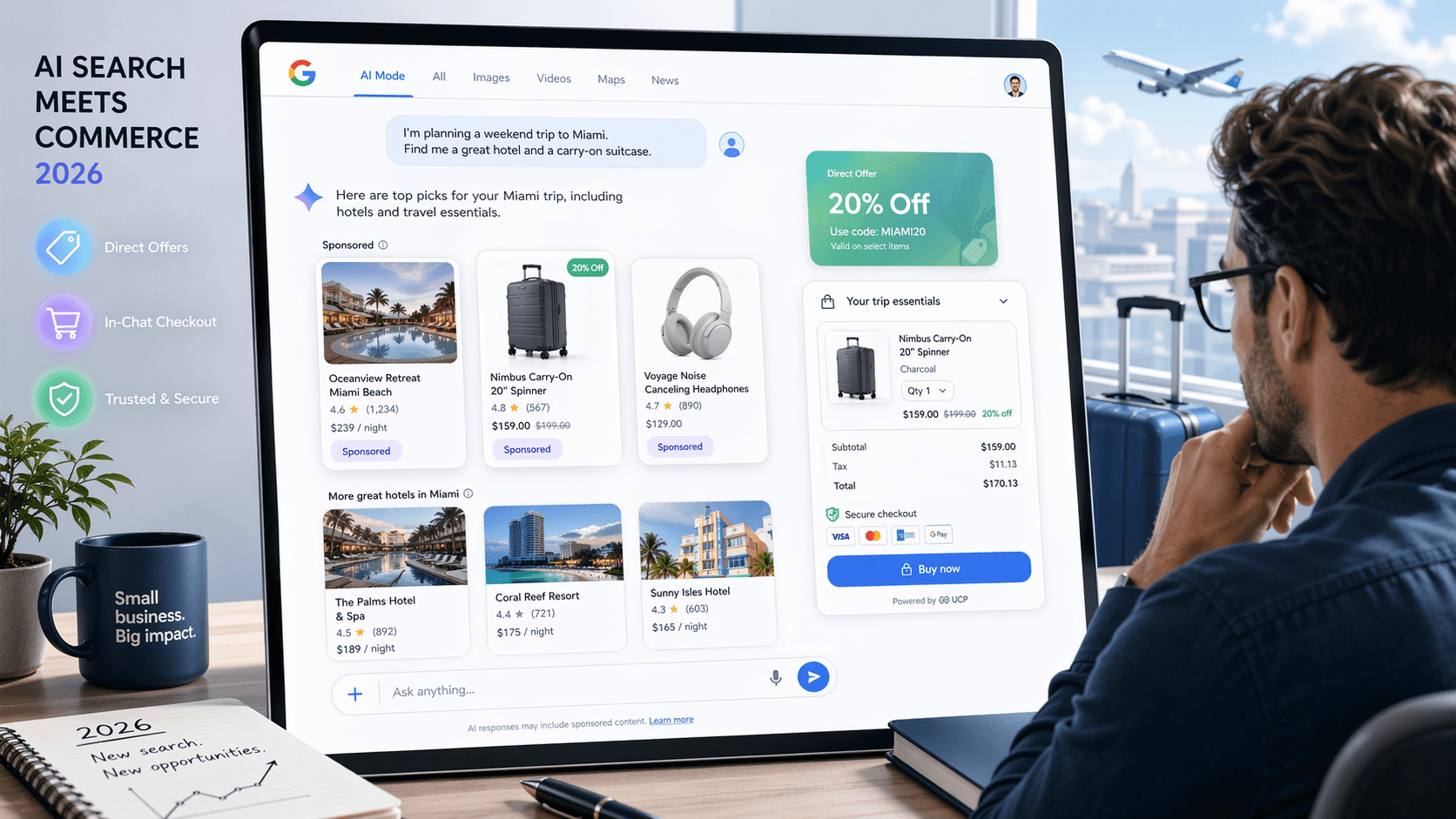
Table of Contents
Something significant changed about Google in April 2026 — and most business owners haven't heard about it yet. Google is now placing ads directly inside its AI-powered search conversations. If you sell products or services online, this affects you. Here's what's happening, straight from Google's own announcements, and what you can do about it.
What Exactly Changed?
You've probably noticed that Google search has been getting more conversational. Instead of typing in a few keywords and scrolling through links, more people are asking Google full questions and getting back a full AI-generated answer. That feature is called AI Mode.
For a while, AI Mode was ad-free. That changed this spring. In its official Ads & Commerce Blog, Google announced it is now testing sponsored product listings inside those AI conversations. When someone asks AI Mode a shopping question — say, "What's a good stand mixer for a beginner baker?" — they now see labeled "Sponsored" listings alongside the AI's organic recommendations.
"AI Mode already surfaces organic shopping recommendations based on what's most relevant to a query. Now, we're testing a new ad format to showcase retailers that offer those products, clearly marked as sponsored."— Vidhya Srinivasan, VP of Ads & Commerce, Google — blog.google, February 2026
The same kind of sponsored placements are rolling out for travel queries too — hotels, destinations, flights. If your business is in travel or hospitality, this applies to you just as much as it does to retailers.
There's More: Direct Offers and In-Chat Checkout
Beyond the basic ad placements, Google introduced two features that go even further.
The first is called Direct Offers. According to Google's official announcement, this lets businesses present a tailored promotion — like 20% off a specific product — to a shopper who is showing signs of being ready to buy, right inside the AI conversation. Google says they plan to expand this beyond discounts to include loyalty perks and product bundles.
The second is called the Universal Commerce Protocol (UCP). Google launched this in January 2026, and it's already live. U.S. shoppers can now buy items from Etsy and Wayfair directly inside AI Mode — without ever leaving the conversation. Shopify, Target, and Walmart are coming soon.
In Google's own words
"In 2026, agentic commerce is no longer just a concept — it's reality. It will transform how we shop, from discovery to decision, while helping brands differentiate themselves."
— Google Ads & Commerce Blog, February 2026
The short version: Google is building toward a world where someone asks the AI a question, gets a recommendation, sees your ad or offer, and buys — without ever clicking away. The shopping journey is moving inside the conversation.
Why This Is Different From a Regular Google Ad
Standard Google ads show up when someone types in a search query. A lot of those people are still in early research mode — just browsing, not necessarily close to buying. AI Mode is different.
By the time someone is having a back-and-forth conversation with Google's AI about which product to buy, they've already moved well past casual browsing. Their intent is much sharper. According to Google's own research, AI Mode provides a more helpful shopping experience specifically because users can compare a variety of brands and stores at the moment they're ready to make a decision.
An ad that appears at that moment is meeting a much warmer prospect. That's the opportunity. The challenge is that showing up there isn't as simple as flipping a switch.
The Honest Part: Bigger Budgets Have a Head Start
Let's be straightforward about this. Large retailers and enterprise brands with dedicated marketing teams, big ad budgets, and already-clean product data will move fast here. They're ready for this. Many smaller businesses are not — yet.
To show up inside AI Mode shopping results, your product listings need to be in excellent shape. Google's AI works with the information it's given. Thin product descriptions, low-quality images, or inconsistent product IDs across your sales channels will cause the AI to pass over your products in favor of more complete listings — regardless of how great your product actually is.
The good news is that this is genuinely a fixable problem. And unlike trying to outspend a national retailer on competitive keywords, the quality of your product data matters just as much as the size of your budget inside AI Mode.
✦
Meanwhile, Google's Ad System Itself Just Changed
At the same time Google is rolling out AI Mode ads, it's also overhauling how its standard search ad campaigns work — and there's a deadline that affects any business currently running Google Ads.
On April 15, 2026, Google officially moved a feature called AI Max for Search Campaigns out of beta and made it available to all advertisers. AI Max is not a new campaign type — think of it as a smarter engine that layers on top of your existing search campaigns. Instead of relying purely on your keyword lists to find customers, it uses AI to find relevant searches beyond your exact keywords, then dynamically adjusts your ad copy and landing pages to match what each person was looking for.
7% | 14% |
|---|---|
Average conversion lift when using AI Max's full feature suite | Conversion lift reported across AI Max campaigns on average |
Sep '26 Deadline: older Dynamic Search Ads auto-upgrade to AI Max, whether you're ready or not
That September deadline matters. Google has confirmed that any campaigns still running Dynamic Search Ads (DSA) will be automatically migrated to AI Max in September 2026. You won't be able to opt out. Businesses that upgrade now — on their own terms — will have more control over how their campaigns are configured than those who wait for the automatic switch.
If you're currently running Google Ads and you're not sure whether this applies to you, it's worth checking with whoever manages your account.
So What Should You Actually Do?
Clean up your Google Merchant Center listings
If you sell products online, log into Google Merchant Center and audit your product listings. Are your titles descriptive? Are descriptions thorough? Are your images high-resolution and accurate? This is the foundation everything else is built on — and it costs nothing to fix.
For a step-by-step walkthrough of exactly what to fix, optimizing your free Google Shopping listings covers product titles, categories, pricing, and mobile experience in detail.
Make sure your product IDs are consistent everywhere
Google is now enforcing consistency in product IDs across every channel where you sell. If your product codes don't match between your website, Google Shopping, and any marketplaces you use, your listings will be flagged. This is a technical detail, but it has a real impact on whether you show up in AI Mode results.
Ask your ad manager about the September AI Max migration
If someone manages Google Ads for you, ask them: are our Dynamic Search Ads set up to transition to AI Max before September? Are we using the voluntary upgrade tools now, while we still have full control over the configuration? Early movers have a clear advantage here.
Update your Google Business Profile
For service businesses and local businesses especially, your Google business profile feeds into how AI Mode represents you. Up-to-date hours, services, photos, and a healthy review count all contribute to how the AI describes and recommends you when someone asks a relevant question.
Think about how your business reads to an AI
AI Mode pulls information from your website, your product listings, your structured data, and your business profile. If someone asked an AI to describe what your business offers and why it's worth choosing, could it answer that well from what's publicly available? If the answer is no, that's the work to do first.
The Bigger Picture: Search Is Not What It Used to Be
Google generated more than $400 billion in revenue in 2025, with ad revenue up over 13% year over year. The company is not experimenting with AI Mode ads out of curiosity — this is their core business evolving in real time. In 2025, Google delivered what Vidhya Srinivasan described as "a decade's worth of innovation in 12 months." The pace isn't slowing down.
The era of search being a list of ten blue links is over. The new version of search is a guided conversation. Your business either shows up in that conversation — with accurate information, good product data, and the right ad setup — or it doesn't get considered. There's no middle ground in a conversational recommendation.
"We aren't just bringing ads to AI experiences in Search; we are reinventing what an ad is."— Vidhya Srinivasan, VP of Ads & Commerce, Google — blog.google, February 2026
For small and mid-sized businesses, the path forward isn't to try to outspend enterprise brands. It's to be better prepared. Clean data. Current listings. A Google presence that an AI can actually work with. Businesses that get those fundamentals right now will be in a meaningfully stronger position six months from now than those who wait.
Your April 2026 Action List
Log into Google Merchant Center and audit your product listings — fix thin descriptions, poor-quality images, and any missing data
Verify that your product IDs are consistent across every place you sell (your website, Google, and any third-party marketplaces)
Ask your Google Ads manager whether your campaigns are using Dynamic Search Ads and whether a migration plan to AI Max is in place before September
Review and update your Google Business Profile — hours, services, photos, and responses to recent reviews all matter to AI Mode
Check your website's product or service pages: are they detailed enough for an AI to understand and recommend you?
If you're in travel or hospitality, ask your ad manager specifically about AI Mode travel ad placements — these are now live
If your Google Shopping campaigns are still set up the old-fashioned way, prioritize a full audit before the September deadline
The Bottom Line
Google placing ads inside AI conversations is not a minor update — it's a fundamental shift in how people discover and buy products online. The businesses that will benefit most are the ones that take the time now to make sure their product data is clean, their listings are current, and their Google Ads campaigns are ready for a system that rewards quality inputs over brute-force spending.
You don't need an enterprise budget to be competitive here. You need good information and the right setup. That's always been the edge smaller businesses can use — and it applies just as much in AI Mode as it ever did in traditional search.
Sources: Google Ads & Commerce Blog — What to Expect in Digital Advertising and Commerce in 2026 (Feb 11, 2026); Google's Dynamic Search Ads Are Upgrading to AI Max (April 2026); CNBC — Google Launches Universal Commerce Protocol (Jan 11, 2026); Modern Retail — Google Says AI-Powered Ads Help Some Brands Lift Online Sales by 80% (April 7, 2026). This article is intended as a plain-English overview for business owners and does not constitute legal, financial, or advertising advice.
Let’s talk about your next step.
Schedule a free 15-minute consultation with SOURCEsem. Tell us about your business, ask your questions, and get clarity on where to focus next.


