How to Get AI Tools Like ChatGPT and Perplexity to Recommend Your Business
Category
Content
Posted on
Updated

Author
Daria Nikolaeva
SEO & AI Search
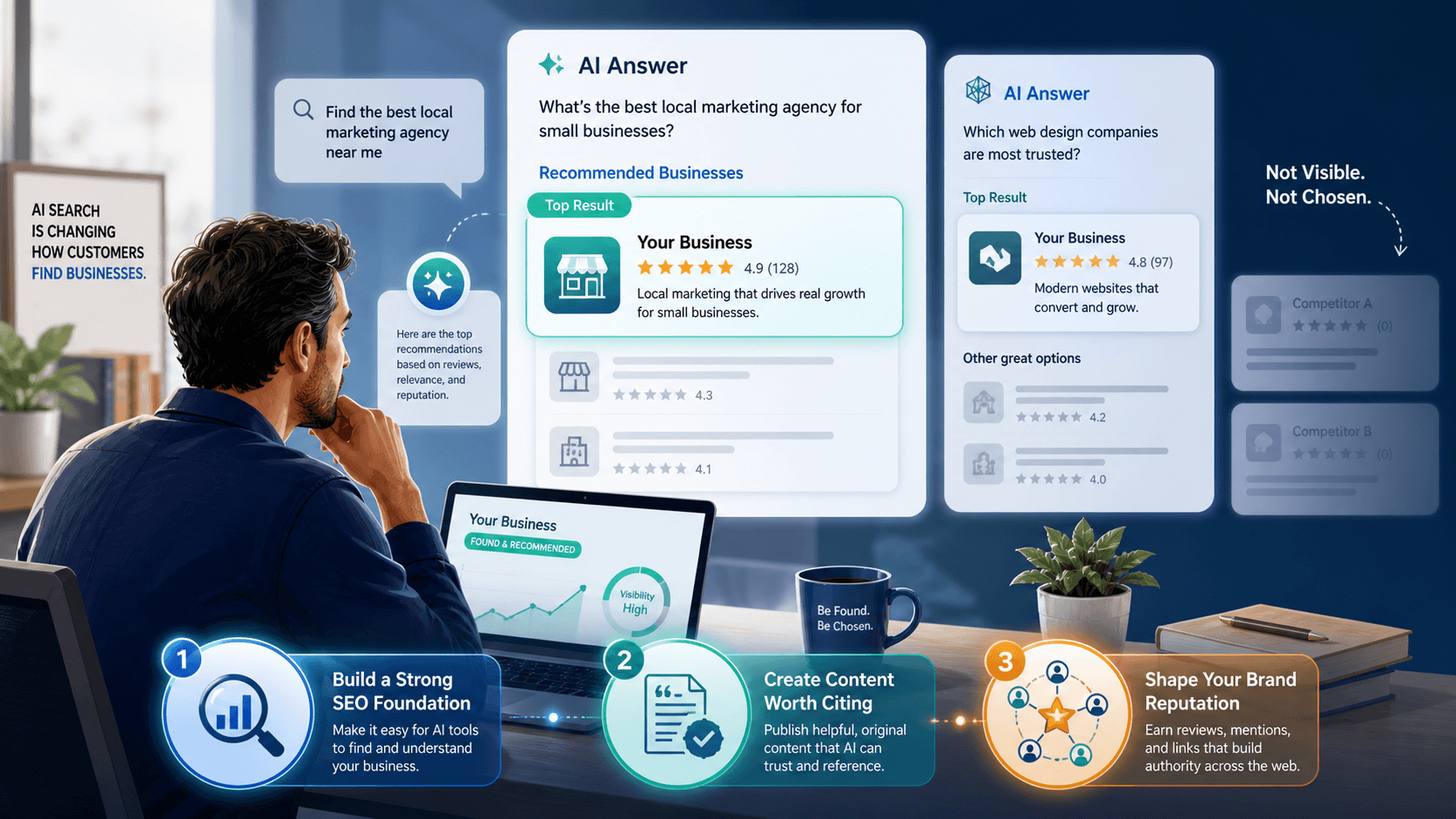
Table of Contents
How do I get my business to show up in ChatGPT and AI search results?
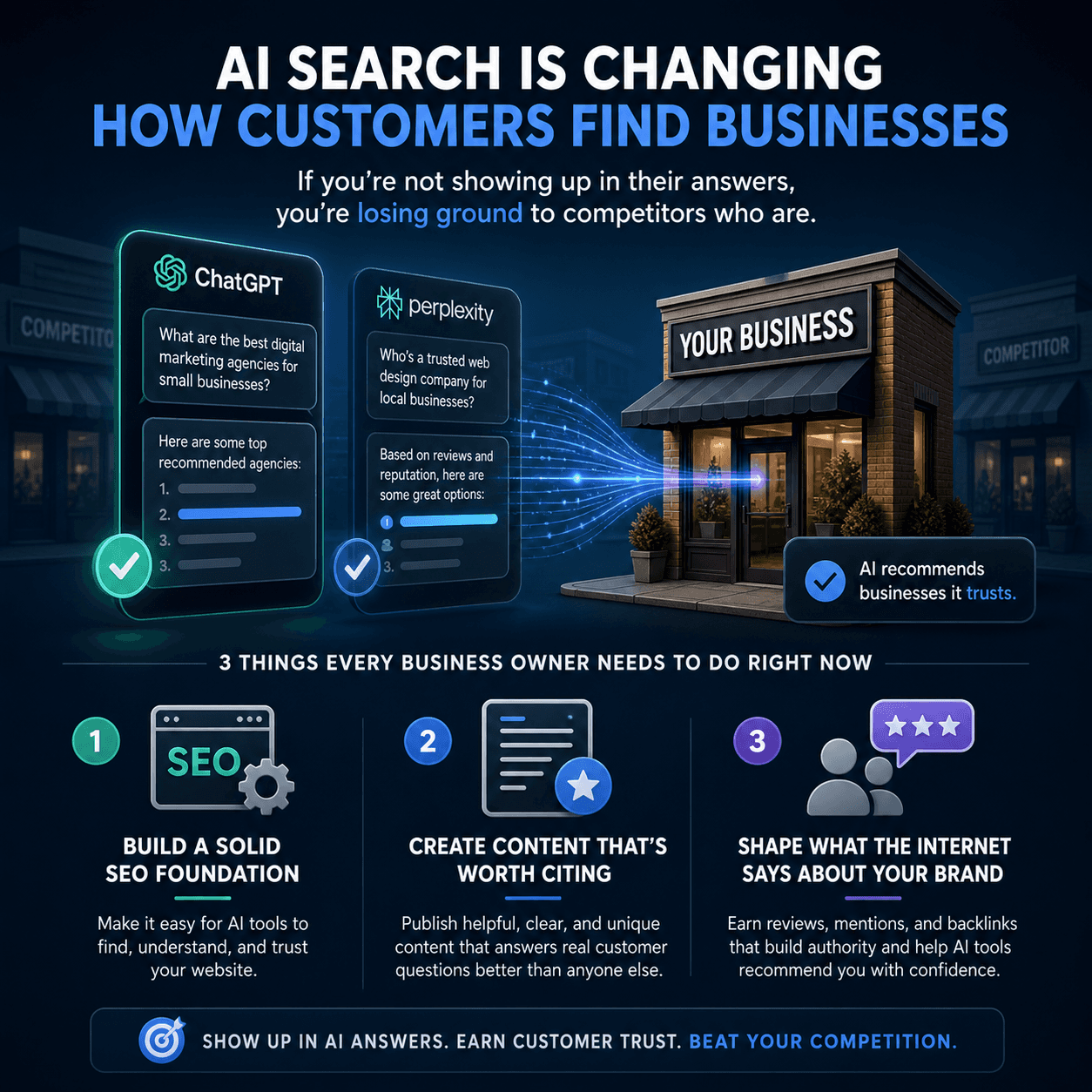
AI search tools like ChatGPT and Perplexity are changing how customers find businesses — and if you're not showing up in their answers, you're losing ground to competitors who are. This guide breaks down the three things every small and mid-sized business owner needs to do right now: build a solid SEO foundation so ai tools can find you, create content that's genuinely worth citing, and shape what the broader internet says about your brand so AI tools recommend you with confidence.
The way people find products and services online is changing faster than most business owners realize. Here's what you need to do about it — before your competitors do.
Not long ago, if someone wanted to find the best accountant in their city, the right pair of running shoes, or a reliable local plumber, they'd type a few words into Google and scroll through the results. That's still happening — but something has quietly shifted alongside it.
A growing number of people are now opening up ChatGPT, Perplexity, or Google's own AI tools and simply asking: "What's the best option for X?" And here's the critical part: these tools answer. They recommend specific businesses, products, and services by name. And if your business isn't in that conversation, you're invisible to a fast-growing slice of potential customers.
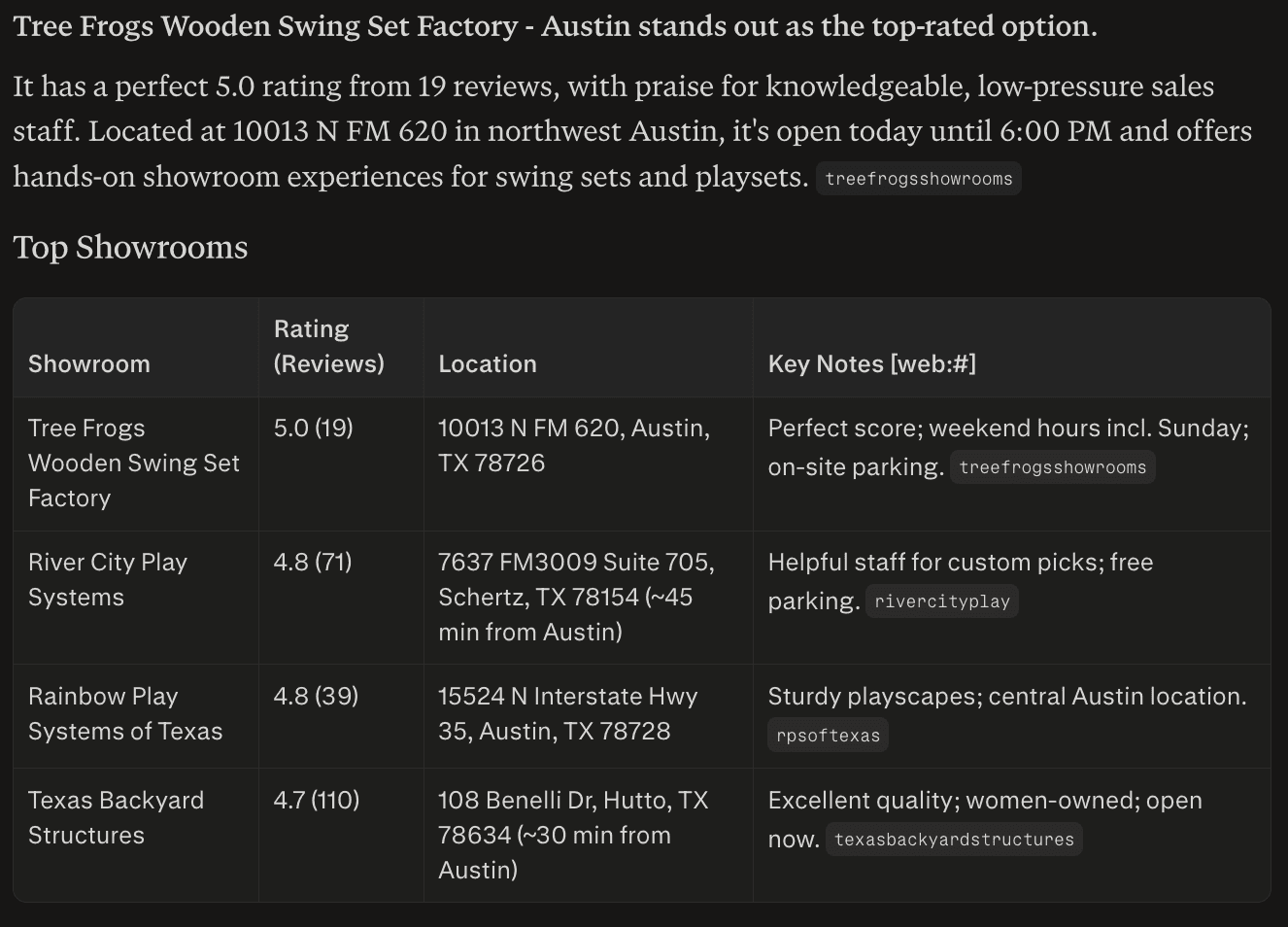
Here is an example of the Perplexity: "What is the best outdoor playset showroom in Austin, TX?"
It highlighted Tree Frogs Showrooms first due to its perfect 5.0 Google rating from 19 reviews, edging out competitors in pure score for an Austin showroom. It also appears consistently in top Yelp lists for playsets and swing sets, with strong praise for knowledge, craftsmanship, service and low-pressure sales staff.
This guide will walk you through exactly what AI search optimization is, why it matters for businesses of your size, and the practical steps you can take to start appearing in those AI-generated answers.
How can a small business get ahead of competitors with AI search?
The timing of this shift is significant. We're at roughly the same inflection point with AI-powered search that businesses faced in the early days of Google — when a handful of forward-thinking companies built real competitive advantages simply by understanding how the new system worked before everyone else caught on.
The businesses that adapted early to traditional search engines grew. The ones that ignored it lost ground they never fully recovered. AI search is setting up the exact same dynamic.
4x | Q3 | 3 |
|---|---|---|
Growth in AI chat tool users over the past year | 2024 saw a major spike in website traffic from AI chat tools | Core pillars of AI search optimization |
The three pillars of AI search optimization
Getting recommended by AI tools isn't random. These systems are pulling information from the web, synthesizing it, and making judgments about which businesses, products, or services best fit what the person is asking. You can influence that process through three interconnected areas:
Pillar 01 | Pillar 02 | Pillar 03 |
|---|---|---|
Traditional SEO | Content quality | Brand mentions & sentiment |
The foundation. AI tools search the web — you need to be there to be found. | AI tools cite sources worth citing. Your content needs to earn that. | What the internet says about you shapes what AI tools say about you. Let's go through each one in enough depth that you actually know what to do. |
Pillar 1: Traditional SEO — the non-negotiable foundation
You might be wondering why you'd need traditional SEO if we're talking about AI tools. Here's the reason: when someone asks an AI tool a question, the tool doesn't just know the answer from thin air. In most cases, it goes out and actively searches the web in the background — using search indexes from Google, Bing, Brave, or proprietary sources, depending on the platform.
In other words, the AI tool is doing the Googling for the user. And it's pulling results from sites that rank well for the relevant terms. If your website doesn't show up in those underlying searches, the AI tool has no way to encounter your business.
The practical implication: Getting ranked in traditional search results is still a prerequisite for AI search visibility. It's not sufficient on its own, but you can't skip it.
For small and mid-sized businesses, this means making sure your website is properly optimized for the search terms your customers actually use. Think about what a potential customer would type — or say aloud — when they need what you offer. Your site should clearly, thoroughly address those topics.
Where to start if your SEO is weak?
✓ Make sure each page has a clear, descriptive title and meta description
✓ Create dedicated pages for each core service or product category you offer
✓ Build out location-specific content if you serve a defined geographic area
✓ Earn links from other credible websites in your industry or community
✓ Make sure your site loads quickly and works well on mobile
None of this is glamorous, but it's the groundwork that makes everything else possible.
For a deeper look at the three most impactful technical SEO foundation factors, the guide covers site speed, Core Web Vitals, and structured data in plain language.
Pillar 2: Content that AI tools actually want to cite
Here's the thing about AI tools recommending sources: they don't have to cite you. If your content is generic, surface-level, or could have been written by anyone (or any AI), there's no reason for the tool to pull it in. It can produce that kind of content itself.
What AI tools consistently reach for are sources that offer something they can't generate independently — real experience, original data, human insight, demonstrated expertise. If you're making the common mistake of building your content strategy around estimated prompt volume, the GEO mistakes most small businesses make explain why that approach falls short — and what to do instead.
"The content that wins in AI search is the content that earns its place as a source — not by gaming a system, but by genuinely being more useful than the alternatives."
How Do You Write Content That AI Tools Want to Cite?
Think about how the best review articles, guides, or how-to posts are structured. They lead with a clear, direct answer to the main question. They explain the reasoning behind recommendations. They share the author's hands-on experience. They acknowledge trade-offs and edge cases. They're written by someone who clearly knows the topic from the inside.
If you run a landscaping company and you write a guide to choosing the right grass seed for your local climate — based on your years of doing this work in that specific region — that's exactly the kind of content an AI tool is likely to pull as a source when someone in your area asks for advice.
What Kind of Content Gets Recommended by AI Search Tools?
Open with a clear summary. Don't bury your main answer. AI tools often pull from the first substantive paragraph of a page.
Use descriptive headings. These help both search engines and AI tools understand what each section covers.
Keep sentences readable. Short, clear sentences are easier for AI tools to parse and quote accurately.
Show your work. Include the specifics — measurements, timelines, costs, results — that only someone with real experience would know.
Make the author visible. A brief bio showing relevant credentials or experience adds legitimacy that AI tools factor in.
A note on AI-generated content: it can be a useful tool for drafting or outlining, but publishing content that's purely AI-written, with no added expertise or original perspective, is unlikely to help your AI search visibility. These tools can recognize the kind of generic output they themselves produce — and won't cite it.
Don't forget video and community content
AI search results often include YouTube videos, Reddit threads, and posts from industry forums. If you're producing videos that explain your work, showcase results, or answer common customer questions, those can surface in AI-generated answers just as written content can. A well-optimized video explaining how your service works could show up when someone asks an AI tool for guidance in your category.
Pillar 3: What the internet says about you
This is the piece most businesses haven't started thinking about yet — and arguably the most powerful lever you have for AI search visibility.
When an AI tool decides whether to recommend a business, it's not just looking at that business's website. It's synthesizing everything it can find across the web: reviews on consumer platforms, mentions in industry publications, discussions in online communities, coverage in local or trade media, product listings on third-party sites. All of that information shapes the picture the AI constructs of your business.
If that picture is clear, consistent, and positive, you're far more likely to be recommended. If it's thin, mixed, or contradictory, you'll be passed over in favor of a competitor with a stronger signal.
How Do You Control What AI Says About Your Business?
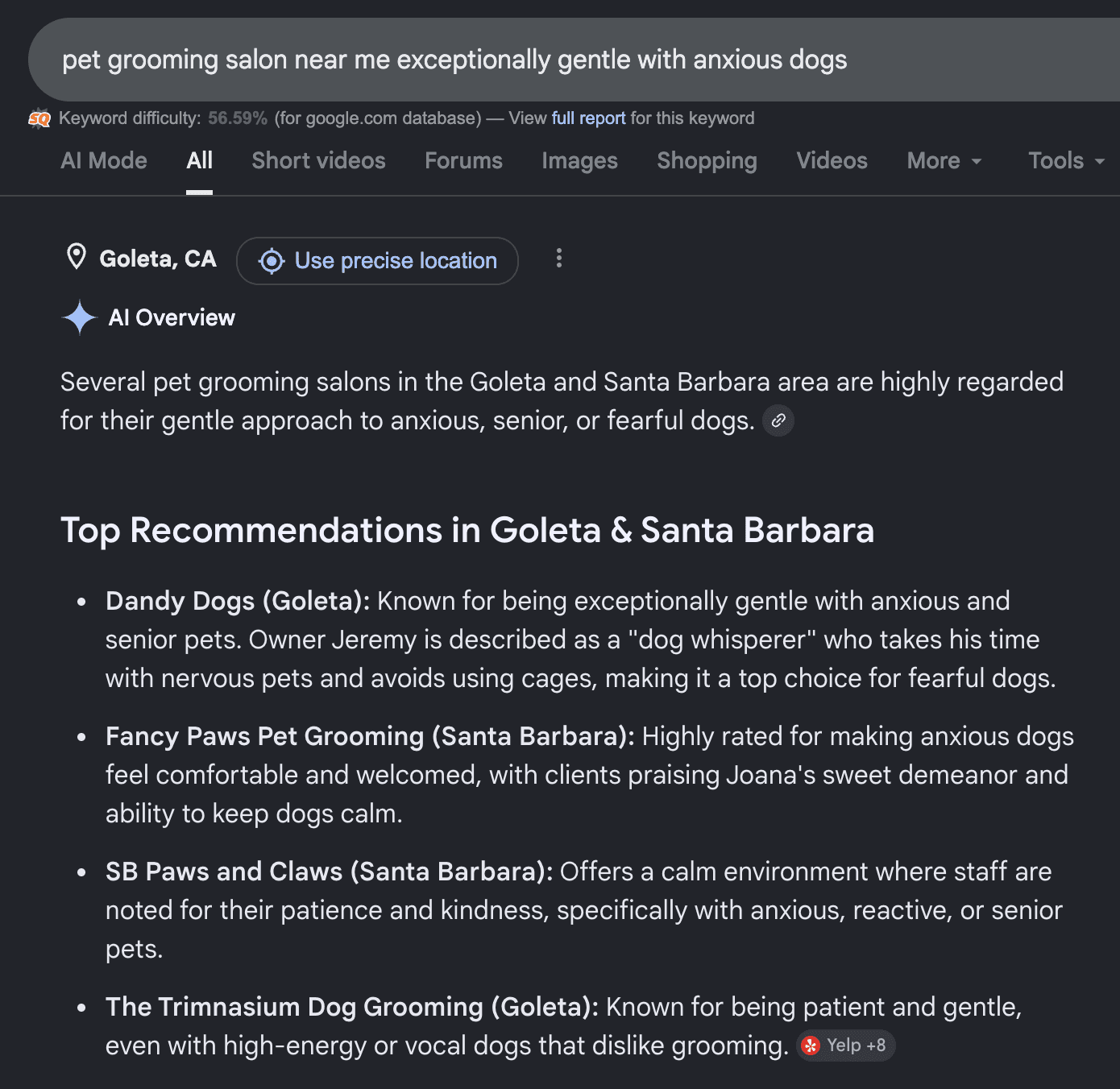
Imagine you run a pet grooming salon and someone asks an AI tool for the best option in your city. The AI might pull from Google reviews, Yelp listings, mentions in a local parenting blog, a Reddit thread from pet owners in your neighborhood, and a feature in a regional lifestyle publication. If all of those sources consistently describe your salon as exceptionally gentle with anxious dogs, the AI starts to form a confident, positive picture of your business around that attribute.
That consistency is the goal. It's not enough to be mentioned in one good place. You want the same positive story being told about you across many different, credible sources.
The importance of knowing what you want to be known for
This requires a level of deliberate positioning that traditional SEO never demanded. In the old model, showing up at the top of a search results page was enough — the customer would click through and evaluate you themselves. In the AI search model, the AI is doing that evaluation on their behalf. It's forming a recommendation, not just showing a list.
That means you need to be intentional about the specific qualities you want associated with your business. Not everything — focus is more powerful than breadth here. A family law firm that wants to be known for clear communication, compassionate handling of difficult situations, and straightforward fee structures will build a stronger AI search presence than one that tries to claim expertise in everything.
A useful exercise: Ask your best existing customers why they chose you over alternatives. What words do they use? What problems did you solve that others couldn't? Those answers are the foundation of the story you want the internet to tell about you.
Practical steps to improve your brand's web presence
✓ Actively solicit reviews on the platforms where your customers are (Google, Yelp, industry-specific sites)
✓ Reach out to local and industry publications about contributing articles or being featured
✓ Respond to discussions in online communities relevant to your field — add genuine value
✓ Build relationships with bloggers or content creators who cover your category
✓ Ensure your business is listed accurately on all major directories and data aggregators
Start with the basics — a complete Google Business Profile setup is one of the strongest local signals you can give AI tools, and this checklist covers every step.
✓ Consider a press outreach effort around anything genuinely newsworthy in your business
How to measure your AI search visibility
That's where tools to track your AI search presence come in — and understanding how they work will save you from chasing data that doesn't actually tell you anything useful.
One of the practical challenges of AI search optimization is that it's harder to measure than traditional SEO. When you want to know where you rank on Google, you check a ranking tool and get a number. AI search is fuzzier — each answer is generated fresh, and results can vary based on how a question is phrased.
Tools are emerging to address this. Platforms like Semrush now include AI-specific tracking features that let you monitor how often your brand appears in AI-generated answers, what sentiment those mentions carry, and how you compare to competitors across different AI platforms.
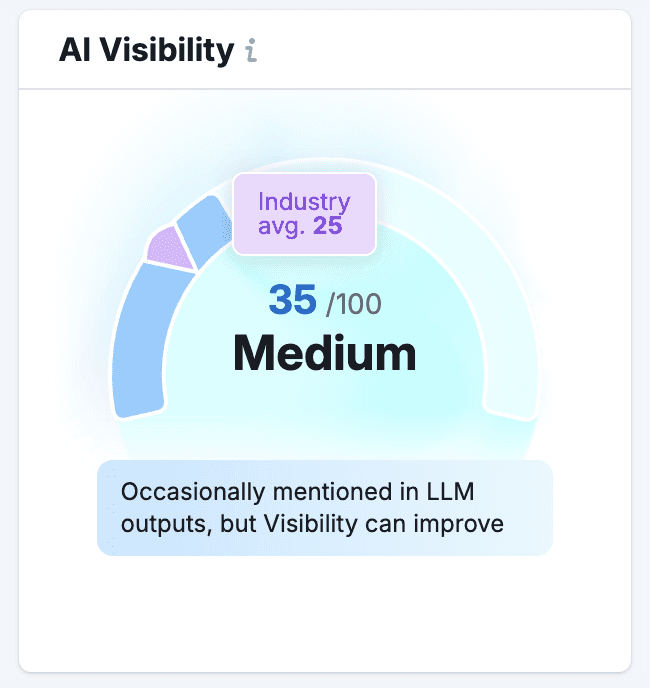
These tools also tend to surface something genuinely useful for small business owners: insights into what customers actually think about you, what questions they're asking that you're not answering, and where gaps exist in your category. It's market research and competitive intelligence wrapped into the same dashboard.
Even without a paid tool, you can run your own informal audits. Open ChatGPT, Perplexity, or Google's AI features and ask the kinds of questions your customers would ask. See who gets recommended. Note the sources being cited. That gives you a clear picture of the landscape you're competing in.
A realistic timeline: what to expect
Some of these changes take effect faster than you might expect, and some require sustained effort over months.
Within days to weeks: Content structure improvements — clearer summaries, better headings, more scannable formatting — can begin showing up in AI-generated answers relatively quickly after being indexed.
Within weeks to months: On-page SEO improvements and new content that targets specific questions will start building search visibility, which feeds into AI search presence.
Over months to a year or more: Building meaningful brand presence across the web — reviews, media coverage, community mentions — is a longer-term project. But it's also the most durable competitive advantage, because it's genuinely hard for competitors to replicate quickly.
The businesses that start this work now will be the ones with the strongest position when AI search becomes the dominant way people find what they're looking for — which, based on current trajectories, is not far off.
The bottom line
AI search optimization isn't a replacement for good marketing fundamentals. It builds on them. The businesses best positioned to win here are the ones that already do the basics well — a solid website, genuine expertise, happy customers willing to talk about their experience — and now layer on a deliberate strategy for how that story gets told across the web.
If you're a small or mid-sized business owner reading this, the most important thing to take away is this: the window to get ahead of this is still open. Your competitors are probably not moving on it yet. The businesses that figure this out first will have a real advantage — just like the early adopters of search engine optimization did two decades ago.
Start with an honest look at where you stand today. Is your website findable for the questions your customers ask? Is your content genuinely useful, or just filler? What does the internet currently say about you — and is that the story you want being told to an AI tool making a recommendation on your behalf?
Answer those questions honestly, and you'll know exactly where to begin.


