Local SEO Case Study: How a Local Clinic Now Shows Up in 96% of Its Google Searches
Category
Content
Posted on
Updated

Author
Daria Nikolaeva
SEO & AI Search
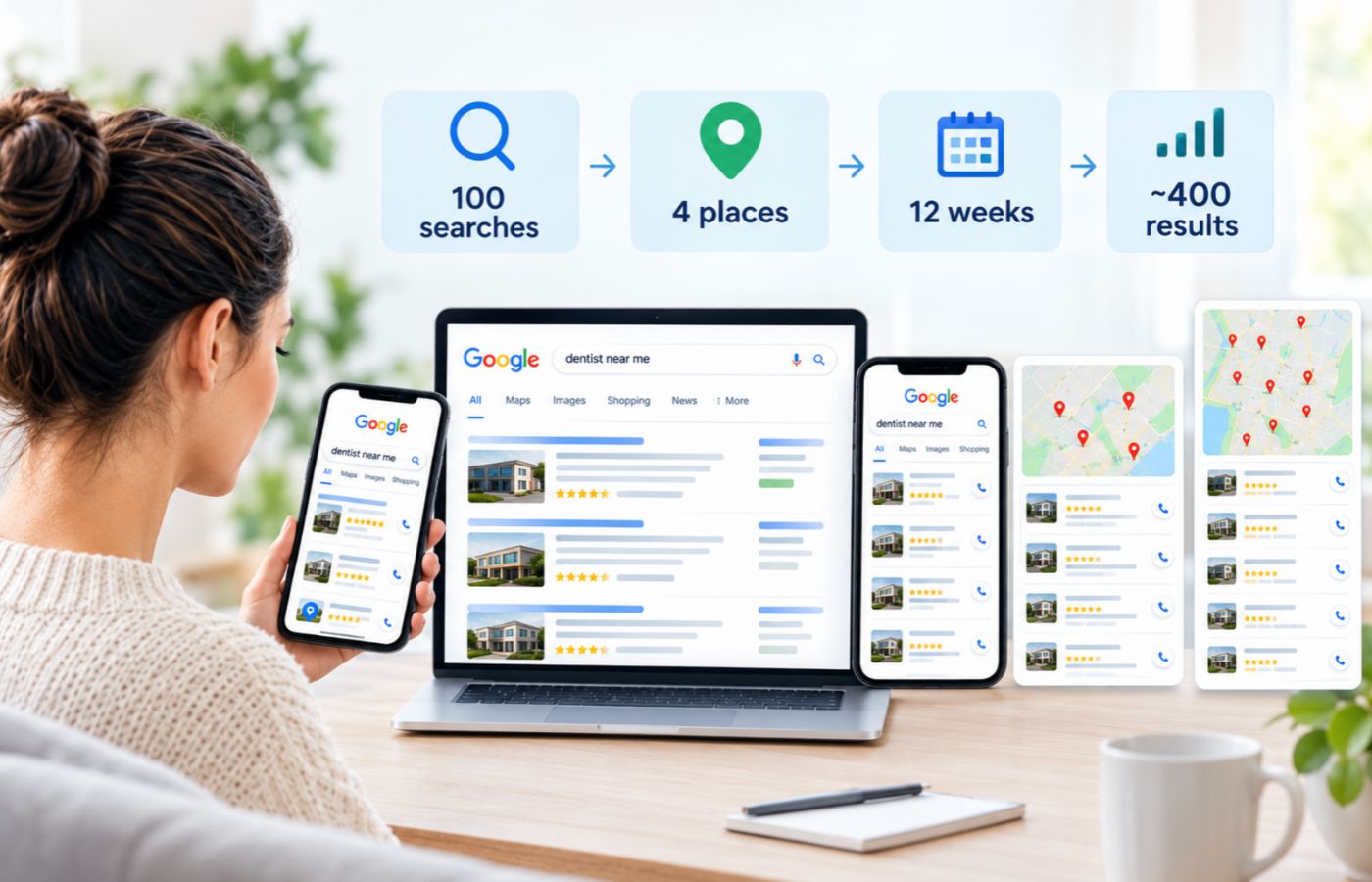
Table of Contents
We tracked 100s of searches patients actually use in 4 places where Google shows results: regular search results on Google desktop, regular results on mobile, the map box (the 3 businesses shown under the map), and the full map list. 100 searches × 4 places = about 400 tracked results, checked every week for 12 weeks.
The challenge
Patients don't all search the same way. One types the name of a service, another describes a symptom, another just types "near me." A clinic can rank #1 for its most obvious search and still be invisible for the dozens of other phrases that actually fill its calendar.
Patients also rarely book on the first click. They compare options, read reviews, and usually see a clinic several times before they call. Every time you show up is another chance to be remembered.
When we started, this clinic didn't appear at all in 58 of its roughly 400 tracked results. For a real share of the ways patients search, it simply wasn't there.
What we did
This wasn't a one-time fix. Four things worked together over the full 12 weeks.
Turned the Google Business Profile into a front door. Your profile is the box with your hours, photos and reviews that appears on Google Search and Maps. We corrected and updated every detail, listed every service and product in the words patients actually search, added quality photos, and posted updates on a regular schedule so the profile never went stale.
Made reviews a steady habit. Reviews are one of the biggest things Google weighs when deciding who shows up on the map. We added a simple review request after each appointment, so new reviews arrived every week instead of in random bursts. We also featured them on the website, where patients compare options.
Fixed and expanded online listings. Your business name, address and phone number appear on dozens of directories across the web. When they don't match, Google trusts your business less. We found and fixed every mismatch, then added the clinic to 20 new top-rated directories each month. It's the least exciting part of the work, and most likely the reason for the biggest win.
Tracked everything, every week. We checked rankings weekly, along with a map grid showing which parts of town saw the clinic and which didn't. That turned "we could be doing better" into a clear to-do list.
We also ran the clinic's social media, email marketing strategy, and ads. Ads don't affect where you rank on Google, so the results above come from the local SEO work.
What the results mean
The biggest win in this local SEO case study wasn't at the top. It was closing the gaps at the bottom.
Blind spots closed (58 → 10). The clinic now shows up for almost every way patients search for it. Phrases where it used to be invisible became phrases where it competes.
No more page 2 (8 → 0). Almost nobody clicks to page 2 of Google. Every listing that was stuck there moved up.
More top rankings (+22% #1, +23% top 5). The first few results get most of the clicks, and the clinic now holds far more of them.
Average position 3.2. Across all 100 searches and all 4 places, the clinic now sits near the top of page 1 on average, up from 7.6.
96% map coverage. Of every map box the clinic could appear in, it appears in 96%. There's almost nothing left to win there.
Showing up twice on the same page. For many searches, the clinic holds #1 on the map and #1 in the regular results at the same time, on desktop and mobile. Google often shows a business in only one of those places, so appearing in both gives the clinic roughly twice the space of a competitor.
What this means for your business
Most businesses check 3 or 4 obvious keywords and assume they're doing fine. In this local SEO case study, the clinic's biggest gains came from searches nobody was watching: service names, symptoms and "near me" phrases.
If you don't track those searches, you can't see your blind spots. And if you can't see them, you can't fix them.
Get your free Google Visibility strategy. Book a Call →
Let’s talk about your next step.
Schedule a free 15-minute consultation with SOURCEsem. Tell us about your business, ask your questions, and get clarity on where to focus next.


