How an AI Search Monitoring Platform Can Improve Your SEO Strategy
Category
Content
Posted on
Updated

Author
Daria Nikolaeva
SEO & AI Search
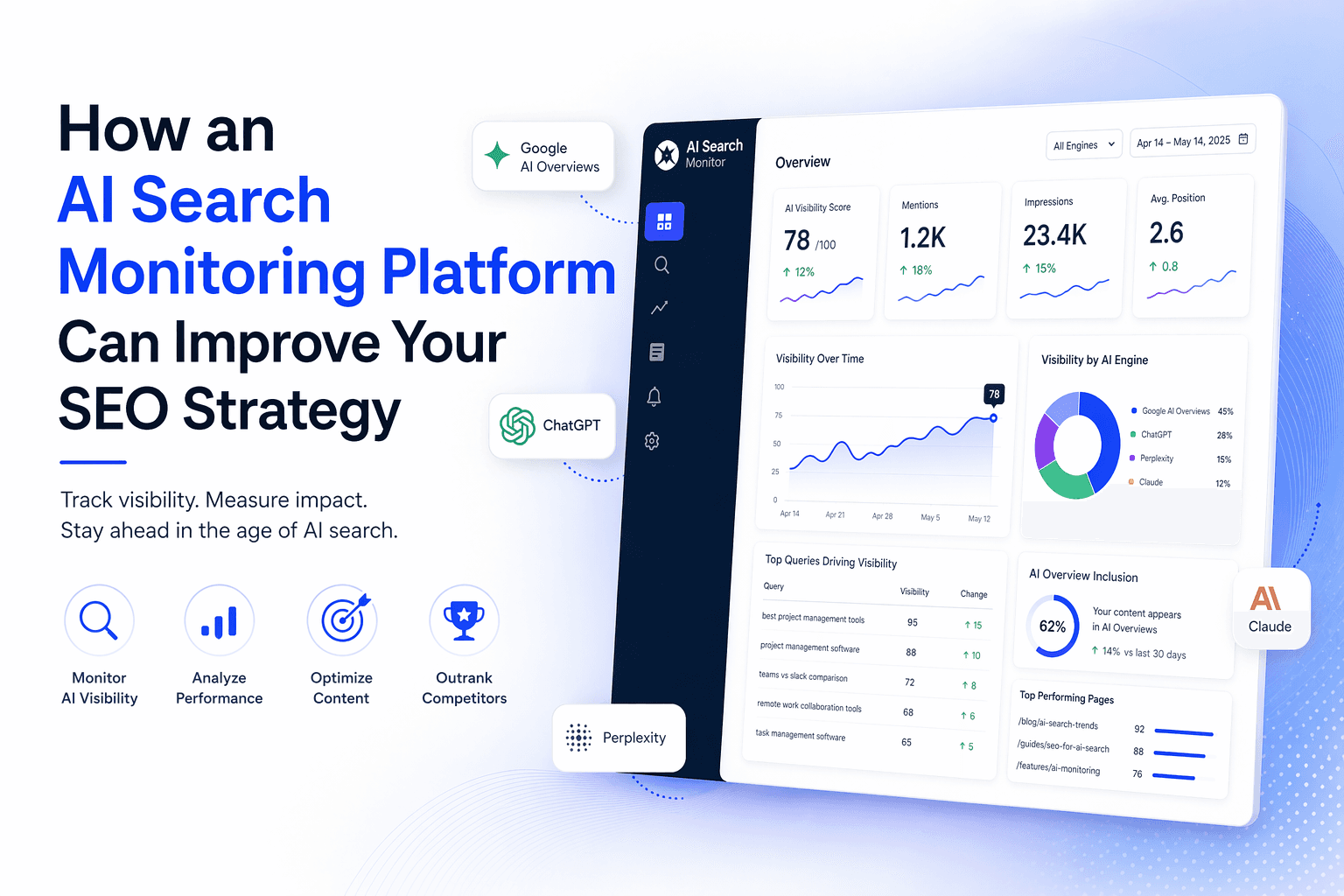
Table of Contents
Imagine you run a small marketing agency. A potential client Googles a question you know your business can answer perfectly — but instead of finding your website, they get an AI-generated summary at the top of the page, built from your competitor's content. They read it, feel satisfied, and never scroll down to find you.
That is what is happening to thousands of small and medium-sized businesses right now. And most of them have no idea.
Search has changed. Google, Bing, and tools like Perplexity now use artificial intelligence to write answers directly on the search results page — pulling from websites they trust. If your content is not one of the sources they trust, you get skipped. Understanding how an AI search monitoring platform can improve your SEO strategy is key to preventing that from happening.
This guide is written for business owners and marketing managers — not SEO experts. No jargon, no fluff. Just a clear explanation of what is going on, why it matters, and what you can do about it.
If you want the strategic foundation before diving into monitoring, building a GEO strategy worth tracking covers the three pillars every business needs to get right first.
Search Has Changed — Here Is What That Actually Means for Your Business
A few years ago, showing up on the first page of Google was the goal. You optimized your website, earned some backlinks, and hopefully landed in one of the top spots. Simple enough.
Today, things work differently. When someone types a question into Google — like "best accounting software for small businesses" or "how to reduce employee turnover" — Google often answers the question itself, right at the top of the page, before showing any website links at all. This is called a google ai overview.
Plain EnglishA Google AI Overview is like having a robot read dozens of web pages and write a short summary answer for the person searching. The robot picks which pages to pull from — and if yours is not one of them, you are invisible, even if you rank well in regular search results.
The same thing happens on Perplexity (a search tool popular with researchers and professionals) and Microsoft's Bing Copilot. All of them pull from websites they consider credible and write their own answers — with or without linking back to you.
So the new question is not just "do I rank on page one?" It is also "am I one of the sources AI is pulling from when it writes answers for my potential customers?" That is a completely different problem — and it requires a different tool to track it.
What Is an AI Search Monitoring Platform?
An AI search monitoring platform is a tool that watches how AI-powered search engines talk about your business — and your competitors — across thousands of searches, automatically.
Think of it like a listening service. Instead of you manually typing questions into Google and checking whether your business shows up in the AI answer, the platform does that at scale, 24/7, and gives you a dashboard showing your results over time.
Real-world exampleSay you run a small HR consulting firm. The platform might track 50 different questions your potential clients ask — things like "how to write an employee handbook" or "best HR software for teams under 50." It checks whether your business gets mentioned in the ai answers to those questions, and whether your competitors are showing up instead of you.
That is the core of what strategies improve brand visibility in AI search engines — knowing where you stand so you can act on it. You cannot improve what you cannot see.
What Does It Actually Track?
Here are the four main things a good AI search monitoring platform watches for you, explained simply:
1. Are you being mentioned?
Every time the platform checks a relevant question, it records whether your business name or website was included in the AI's answer. Over time, you can see your "mention rate" — what percentage of relevant searches include you. Think of this as your score. The higher it is, the more visible you are in AI search.
2. Who is showing up instead of you?
Just as important as knowing your own score is knowing your competitors' scores. If a rival business is being mentioned in AI answers for questions you should be answering, the platform shows you that — and for exactly which questions. That tells you precisely where to focus your efforts.
3. Which of your pages are actually helping you?
When AI tools do mention your business, they are usually pulling from one specific page on your website. The platform identifies which of your pages are being used as sources. That is extremely useful — it shows you what kind of content the AI trusts, so you can write more of it.
4. Are things getting better or worse?
By tracking everything over time, the platform shows you whether your visibility is improving or declining — and whether specific changes you make to your website are actually working. Without this, you are just guessing.
Why Your Old SEO Tools Cannot Do This
You might already use an SEO tool — something like SEMrush, Ahrefs, or Google Search Console. Those are great tools. But they were built for the old world of search, where the goal was ranking in a list of blue links.
They will tell you what position your pages hold in search results. What they cannot tell you is whether you are being included in AI-generated answers — which now appear above those results for millions of searches every day.
Simple analogyYour old SEO tools track your position on a scoreboard. An AI search monitoring platform tracks whether you even made it onto the field.
This is not about replacing your existing tools. It is about adding a new layer of visibility for the part of search that your existing tools are blind to. The two work together — your SEO fundamentals still matter, but now you also need to know how AI search engine optimization tools can show you where AI is shaping the conversation around your business.
If you're not ready to invest in a paid platform, there are also free AI tools that help with monitoring — that list includes options for tracking AI search visibility at no cost.
What Strategies Improve Brand Visibility in AI Search Engines?
Once you can see where you stand, the next question is: what do you actually do about it? Here are the strategies that work — written for people running a real business, not an SEO department.
Before building your strategy, it's worth understanding why 'prompt volume' data is unreliable — most GEO tools are measuring something that doesn't actually exist yet.
Write Content That Directly Answers Questions
AI tools are trained to find the clearest, most direct answer to whatever someone is searching for. If your content buries the answer three paragraphs in, after a lot of background and context, the AI is less likely to use it.
The fix is simple: when you write a blog post or a webpage, answer the main question in the very first paragraph. Then use the rest of the article to explain and expand. This structure — answer first, detail second — is exactly what AI search engines look for.
Try thisPick your most important blog post. Read the first paragraph. Does it actually answer the question the post is supposed to address? If not, rewrite it so it does. That one change can meaningfully improve how often AI pulls from that page.
Use Clear Headings That Match How People Ask Questions
AI tools scan your page's headings to understand what each section is about. If your headings are vague — like "Our Approach" or "Key Considerations" — the AI has a harder time categorizing your content.
Instead, write headings as questions or direct statements that mirror what someone would actually type into a search engine. "How to Reduce Employee Turnover" is a better heading than "Retention Strategies." "What Does Payroll Software Cost for Small Businesses?" is better than "Pricing Overview."
This is one of the most underrated best ways to improve brand visibility in AI search results — and it costs nothing but a few minutes of editing.
Cover a Topic Fully, Not Just Once
AI tools tend to trust businesses that have written about a topic thoroughly — multiple articles covering different angles — over businesses that have written one or two posts on it. The more you cover a subject in depth, the more the AI sees you as a credible expert on it.
For example, if you run an HR consulting firm, you do not just write one article about employee handbooks. You write about how to structure one, what to include legally, how to update it, common mistakes to avoid, and how handbook policies differ by state. Taken together, those articles signal that you really know this space.
A monitoring platform helps you identify which topics you are covering well versus where you have gaps — especially compared to competitors who are showing up in AI answers that you are missing from.
Keep Your Best Pages Up to Date
AI tools, especially those with access to the internet in real time, prefer fresh content. A page that was last updated three years ago is less likely to be cited than one that was reviewed and refreshed recently.
You do not need to rewrite everything. Even small updates — adding a recent statistic, updating an example, or adding a new section — signal to AI tools that your content is current and maintained. Set a reminder to review your top pages every three to six months.
Make Sure Google Understands What Your Page Is About
There is a behind-the-scenes technical step called "schema markup" — a type of code you add to your website that helps Google and other search engines understand exactly what your page is about, who wrote it, and when it was published.
You do not need to know how to code this yourself. Most website platforms (WordPress, Squarespace, Wix) have plugins or built-in settings that handle it. But it is worth checking that your key pages have this set up correctly, because it genuinely helps AI tools understand and trust your content. SOURCEsem can set this up for you.
How to Optimize Your Content for Google AI Overviews
Google AI Overviews are the most important AI search surface for most small and medium businesses — because Google is still where most of your potential customers are searching. Optimizing content for Google AI Overviews does not require a complete website overhaul. It requires a few focused adjustments to how you write.
Lead With the Answer
Google AI Overviews favor pages that answer the question clearly and early. If someone searches "how to reduce employee turnover," a page that opens with "Employee turnover can be reduced by improving onboarding, increasing pay transparency, and building a clear career path for each role" is far more likely to be cited than one that opens with "Employee turnover is one of the biggest challenges facing businesses today."
The first version answers the question. The second version sets up an answer that comes later. Google AI Overviews want the first kind.
Write at a Level Everyone Can Understand
AI Overviews pull from content that is easy to understand and well-written. Overly technical language, industry jargon, and complex sentence structures make it harder for the AI to extract a clean answer — and harder for your readers to trust what you are saying.
A good rule of thumb: write as if you are explaining something to a smart friend who is not an expert in your industry. Clear. Conversational. Specific.
Add Real Examples and Specific Details
Vague advice does not get cited. Specific, practical guidance does. Do not just say "publish good content" — say what good content looks like, give an example, and explain the reasoning. The more useful and specific your content is, the more the AI — and your readers — will trust it. This is central to how you improve visibility in Google AI Overviews over time.
How Do You Know If It Is Actually Working?
One of the best things about using an AI search monitoring platform is that you stop guessing. Instead of wondering whether your content changes are making a difference, you can see it in the data. Here is what to watch, in plain terms:
Your mention rate:The percentage of tracked searches where your business shows up in the AI answer. If this goes up over time, your strategy is working.
Your competitor gap:How often competitors show up in searches where you do not. A shrinking gap means you are catching up.
Which pages are getting cited: Are more of your pages being used as sources over time? That is a sign your content is gaining trust with AI tools.
Downstream effects:Keep an eye on branded searches (people searching your business name directly) and direct website visits. As your AI visibility grows, these tend to grow too — because people saw you mentioned in an AI answer and wanted to learn more.
Most businesses that take this seriously see measurable improvement within two to three months of consistent effort. It is not overnight, but it is also not years. The window is open right now because most of your competitors have not started yet.
That's where tools to track your AI search presence come in — and understanding how they work will save you from chasing data that doesn't actually tell you anything useful
What Should You Look for When Choosing a Platform?
If you are ready to start, here are the questions to ask before you commit. You do not need to be technical to evaluate these — you just need to know what matters.
Does it track Google AI Overviews specifically? This is non-negotiable for most businesses. Some tools only track traditional rankings.
Can you customize which questions it monitors? The most useful platforms let you add the specific questions your customers are actually asking — not just a generic list.
Does it show competitor data? Knowing your own score is good. Knowing it vs. your competitors is what drives decisions.
Does it have historical data? You want to see trends over time, not just a snapshot of today. AI search monitoring historical datais one of the most valuable and least common capabilities in the market — look for it.
Is the dashboard easy to understand? If you need a data analyst to interpret the results, it is not the right tool for a small or mid-size team.
Your First 30 Days: A Simple Action Plan
You do not need a big budget or a full SEO team to get started. Here is a straightforward plan for your first month.
Week 1 | Get your baseline. Set up your monitoring platform and build your query list. Include questions about your service category, things your customers commonly ask, and topics your competitors are targeting. Run your first cycle and record where you stand. |
|---|---|
Week 2 | Find your biggest gap. Look at searches where competitors are mentioned and you are not. Pick the five most relevant to your business — these are your content priorities. |
Week 3 | Fix or create one piece of content. Take your highest-priority gap and address it. Update an existing page or write a new article — answer the question directly in the first paragraph, improve the headings, add a real example. One well-done piece beats five rushed ones. |
Week 4 | Check your results. Compare to your baseline. Look for movement in your mention rate. Plan the next month based on what you learned. Repeat monthly — the improvement compounds. |
The Bottom Line
AI search is not a future trend. It is already changing how your potential customers find businesses like yours — right now, today. The good news is that most small and medium-sized businesses have not started paying attention to it yet, which means there is a real window to get ahead.
How an AI search monitoring platform can improve your SEO strategy comes down to something simple: it shows you what is actually happening in this new layer of search, so you can stop guessing and start making smart decisions about your content.
You do not need to become an SEO expert to benefit from this. You need to know which questions your customers are asking, make sure your content answers those questions clearly, and track whether the AI search tools are taking notice. That is it.
The businesses that start building that habit now — monitoring, creating, improving, repeating — will have a significant head start by the time this becomes common practice. Do not wait for your competitors to figure it out first.
When you're ready to act on what you find, the AI optimization checklist gives you a complete action list covering content, technical signals, and brand presence — all in one place.
Let’s talk about your next step.
Schedule a free 15-minute consultation with SOURCEsem. Tell us about your business, ask your questions, and get clarity on where to focus next.


